The Writer’s Best Comics are Blunt Instruments
As you probably are not aware, Geoff Johns wrote an X-Men book. Well, kind of. None of the X-Men characters are there, it doesn’t even say X-Men anywhere. You probably haven’t heard of it because it’s not collected anywhere outside of Marvel Unlimited and nobody talks about it. It’s also my favorite comic Johns has ever written.
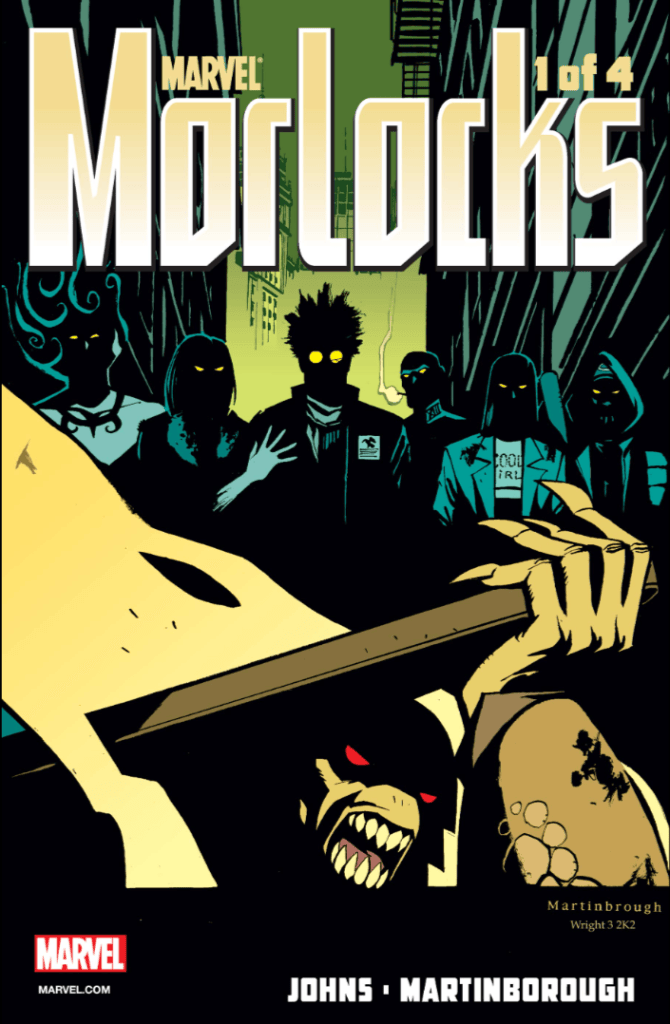
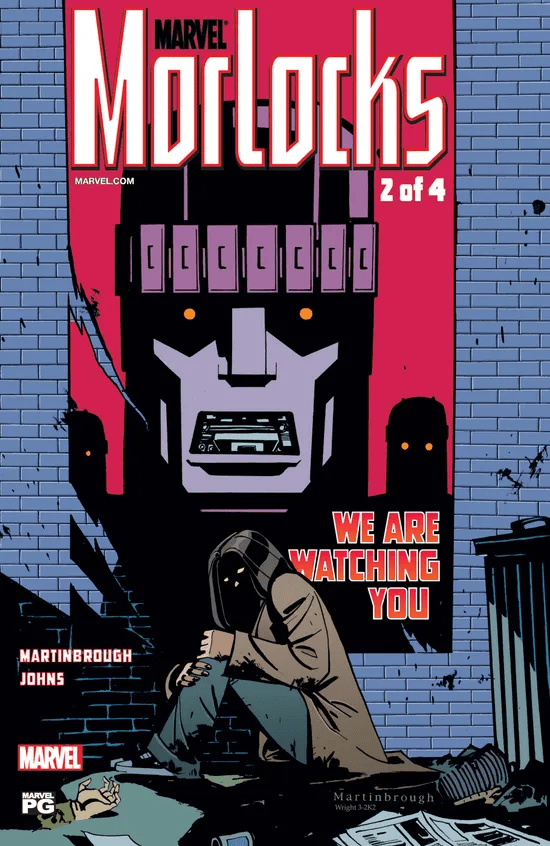
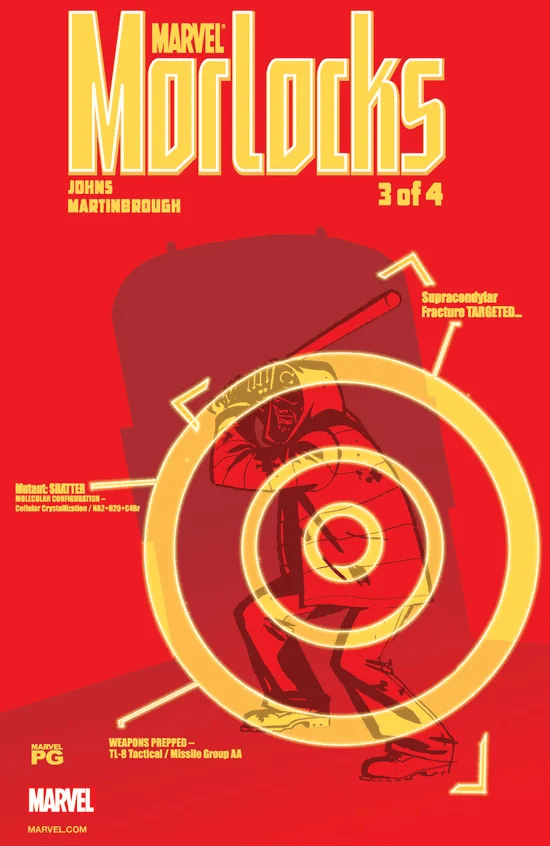
Morlocks is a 2002 mini-series by Geoff Johns, Shawn Martinbrough, Gregory Wright, and Comicraft. It is harsh and unabashedly political. There is little nuance. It is more of a blunt instrument. There’re no superheroes and no cool costumes. The protagonists aren’t vigilantes, and they’re not even the main Morlocks. They navigate using the sewers. They’re fugitives from the law, hunted down with a vengeance by the cops and by Sentinels contracted by the federal government. This is not a new idea to the X-Men universe, in fact it’s a recurring motif. X-Men serve partially to give those hunted down a safe place to stay, an aspect dating back to Giant Size X-Men #1, when Nightcrawler is hunted by an angry mob, or even back to the creation of the Sentinels at the end of the Lee/Kirby run.
“It has been decided, meine freunde. Imagine a generation of young ones who can stop running someday.” -Uncanny X-Men #18 by Gail Simone (Nightcrawler)
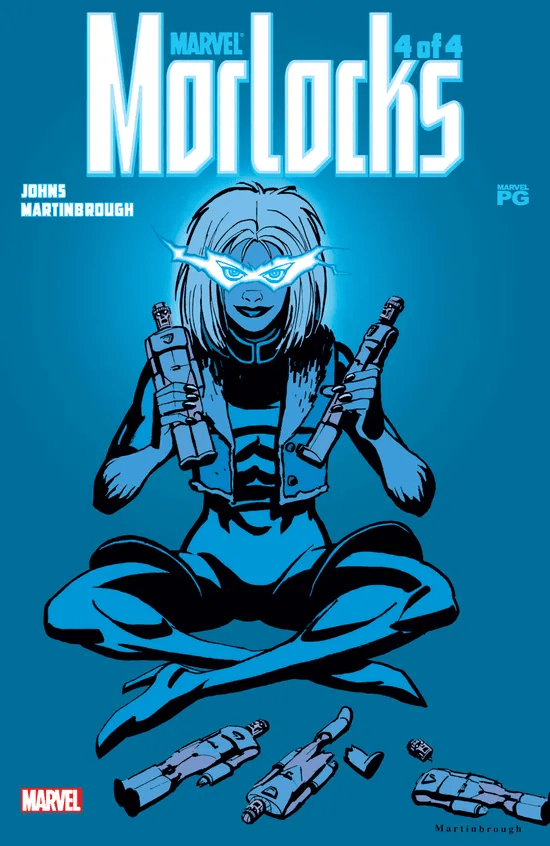
Part of the genius of Morlocks is its simplicity. The plot and premise is straightforward; there’s a group of misfits who each have one last “wish” they want to do on the surface before they leave Chicago. It’s a diverse cast- the leader is Black and the ride-along character is Latino. All but one of them (Postman, the leader) have a physical mutation that unmistakably would mark them as a mutant to any American in the Marvel Universe.
Postman is the star of the show. His power is psychic, not in the general sense but that he can make people forget things by saying the word. He fulfills the Callisto (leader of the NY Morlocks) role not just in that he is the leader, but also that he is the only one without a visible mutation. Callisto is visibly queer, and Postman is a Black man. There is an underlying reality of “I can’t hide anyway” and leaving larger society to become a leader that both Callisto and Postman exhibit, a differing interpretation that depends on the writer and reader.
The racial aspect of the “mutant metaphor” has always been the trickiest for X-Men writers, partially because the majority of whom have been white. (Yes, I am also writing this as a white person.) Chris Claremont was closer to the queer and Jewish perspective of bigotry than he was the Black, Latino, Cheyenne or Apache experience. Where the mutant metaphor falls flat is when it says anti-Black racism is the exact same as homophobia or antisemitism or ableism or the fictional bigotry of the metaphor; that’s when you get scenes like Kitty Pryde saying the n-word in an argument with Stevie Hunter in God Loves, Man Kills. What does work is when X-Men comics talk about how it’s all the same struggle. Angel and Cyclops don’t know exactly what it’s like to be a Morlock, but they do have to recognize the struggle and make it their own fight too.
None of the morlocks go by their given names. They are Electric Eve, Litterbug, Trader, Angel Dust, Shatter, and Postman. They have an ideology, led by Postman, who quotes Malcolm X and guides their ethics, just as the NYC Morlocks are led by Callisto’s ideology.
“We are non-violent with people who are non-violent with us.” -Malcolm X
To me, the most interesting character in Morlocks is Litterbug. He is a former US Army soldier now turned into a fugitive from the federal government. This comic started coming out in June 2002, so likely would have been written after the US invasion of Afghanistan. Litterbug represents the downtrodden soldiers’ gripes with America; a man sold on an ideological and financial promise that his service will be honored and honorable. One of the first actions we see him take is to destroy a poster with an American flag. Later, we see him get his tattoo covered up. This is a man I recognize. A coworker. My late grandfather. Litterbug is another broken promise of the American Dream.
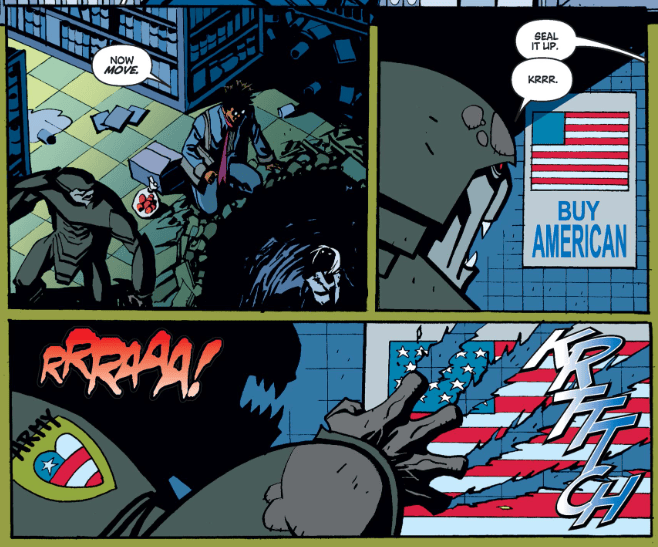
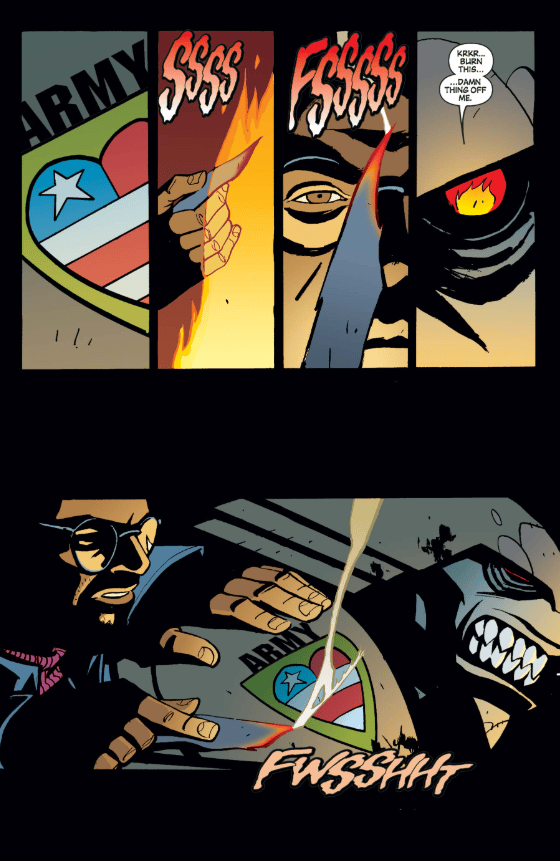
In Spencer Ackerman’s Reign of Terror, he speaks of a “de-trooping” that soldiers and intelligence operatives who spoke out against the wars in Afghanistan and Iraq faced. Any action a soldier makes could be honored as service in the country, even if they commit an atrocity, but the second they clash against the narrative the US military wants to push, they lose that privilege. Like Chelsea Manning and Edward Snowden, Litterbug has been de-trooped.
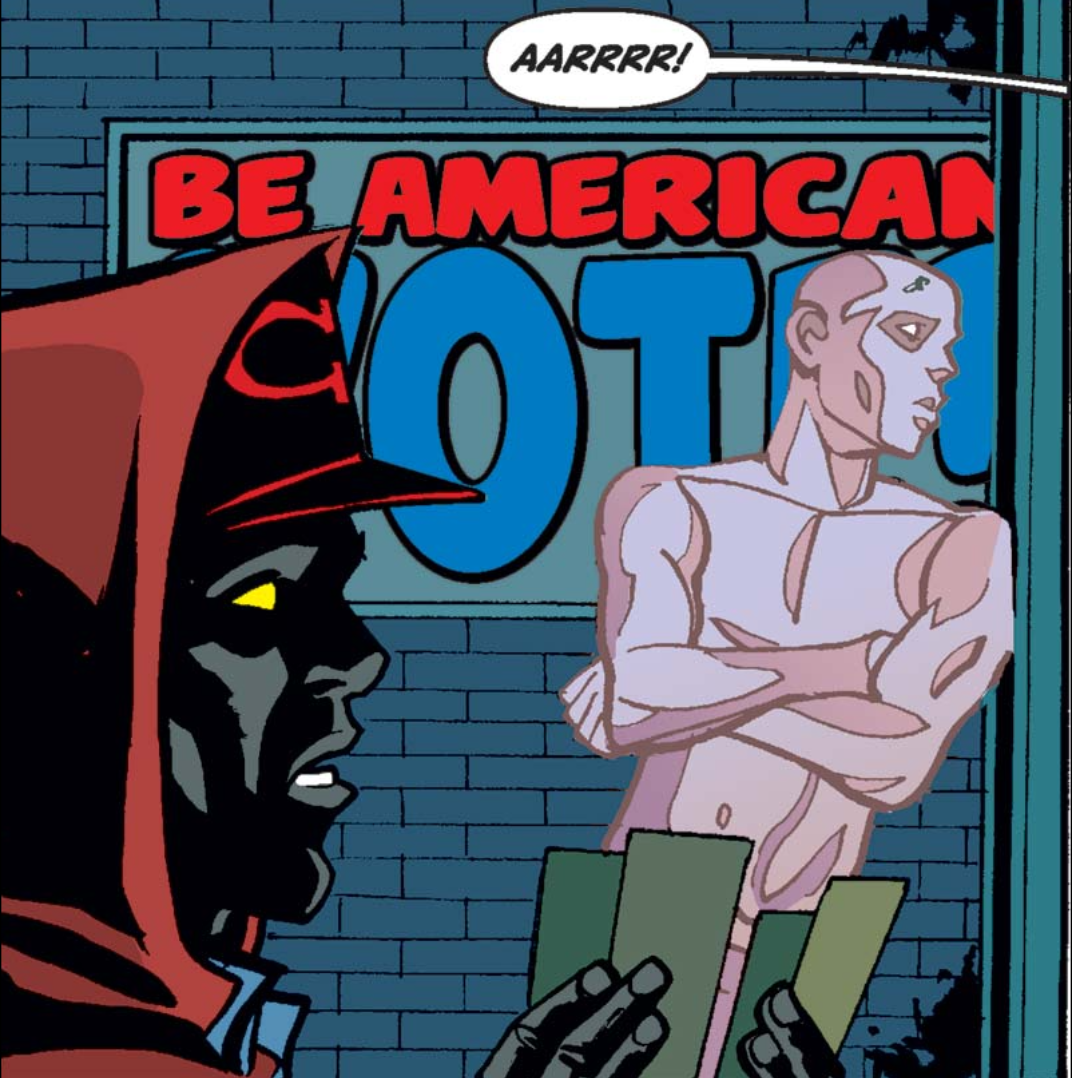
The “Buy American” and other seemingly harmless patriotic propaganda is a background fixture throughout the run. “BE AMERICAN, VOTE”, a nice sentiment, but it feels like a slap in the face to these morlocks. They have been voided their constitutional rights, because they no longer count as American to the powers that be. Those in ICE detention are no longer considered as American by the powers that be. They can’t “vote harder” to save themselves.
As people have said in the few discussions I’ve had about Morlocks online, it is a comic that has become remarkably prescient. As I write this, Immigrations and Customs Enforcement and other forces from the federal government are hunting down immigrants to put in camps and deport, often to countries they have never been to. Local police are assisting them. The ICE agents have killed some people in the streets; more have died of disease and malnutrition in their facilities. When we hear this, we picture the frightening images and videos we have seen since the beginning of the second Trump administration. But of course, all of those things have been true for decades. Johns and Martinbrough were not sage predictors of Americans rapid descent from liberal democracy, but storytellers talking about what always happens in America.
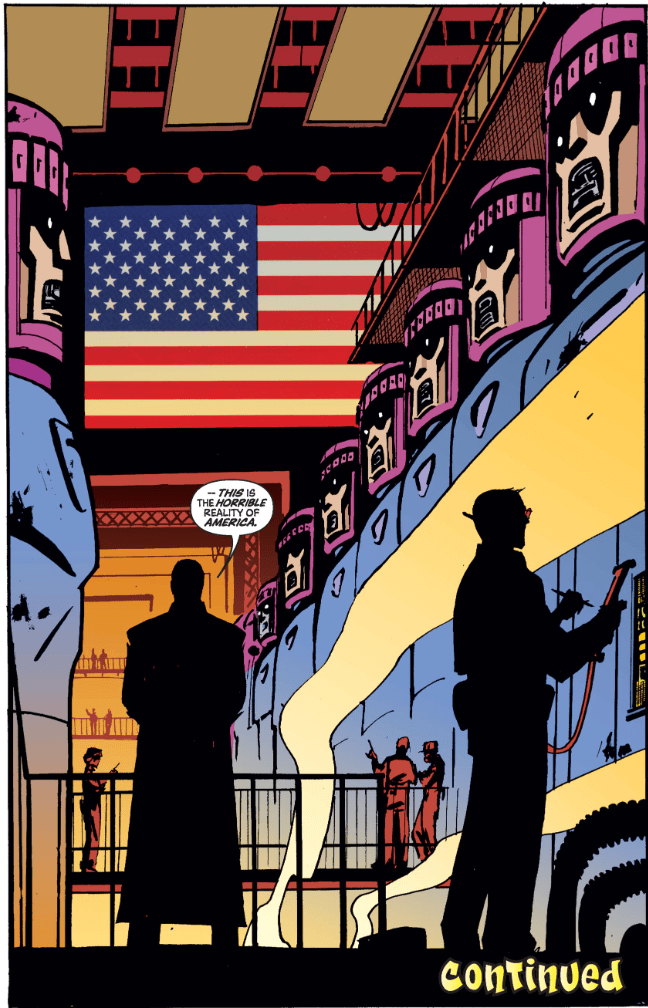
ICE may not have formed until March of 2003, but disgusting acts of deportation were not new. Cops targeting racial minorities and queer communities is an old story.
Obviously, cops and feds do not have robots the size of 737s at their disposal to assist them. Obviously, this is a metaphor. What police across my country do have is an across-the-board militarization and advancement of the tools that they use. Cops have assault weapons and body armor. The national guard is called in to quell protests. Last fall in a suburb of my city, a man was arrested, plead guilty to a misdemeanor, then given over to ICE, all thanks to drone surveillance. (My apologies for the pro-police-anti-rights narrative of the linked article, local news in Indiana is lacking.) There are Flock cameras everywhere. Those are the Sentinels used by the followers of John Sublime and William Stryker use in our reality.
Morlocks is an all-time great X-Men story, from one of the three golden ages of the franchise. The Martinbrough art is as detailed as it needs to be, using its two dimensionality to provide striking images and expressive action. The team juggles its cast perfectly, showing purpose and story for all of them (I don’t have time for), telling a complete and engaging story in just four issues. It’s disconnected from the other comics, but it stays on message. Vulnerable people will fall through the cracks and be targeted; if you’re one of us you need to fight, if you’re not you need to fight for them. It says what it says with vigor and force. It dares you to misinterpret it, to call it “politically correct” or not, or to call it an exaggeration. As Malcolm X put it:
“You get your freedom by not being confined. You get freedom by letting your enemy know that you’ll do anything to get your freedom. You’ll get it. It’s the only way you’ll get it.” -Malcolm X
You are probably more aware that Geoff Johns has written for Action Comics. Superman and the Legion of Super-Heroes (art by Gary Frank, Jon Sibal, and Brad Anderson) is my other favorite comic he has written. It’s covers Action Comics #858-863 in the middle of his great run on the title, but it also steps outside it for a bit to tell an isolated story. Johns is known largely for his large events and long runs, but an argument in this series will be how I believe when you remove all of the status quo and continuity shifts fans are mad at him for, the stories are good. When he gets out of his own way, Geoff Johns is a great writer.
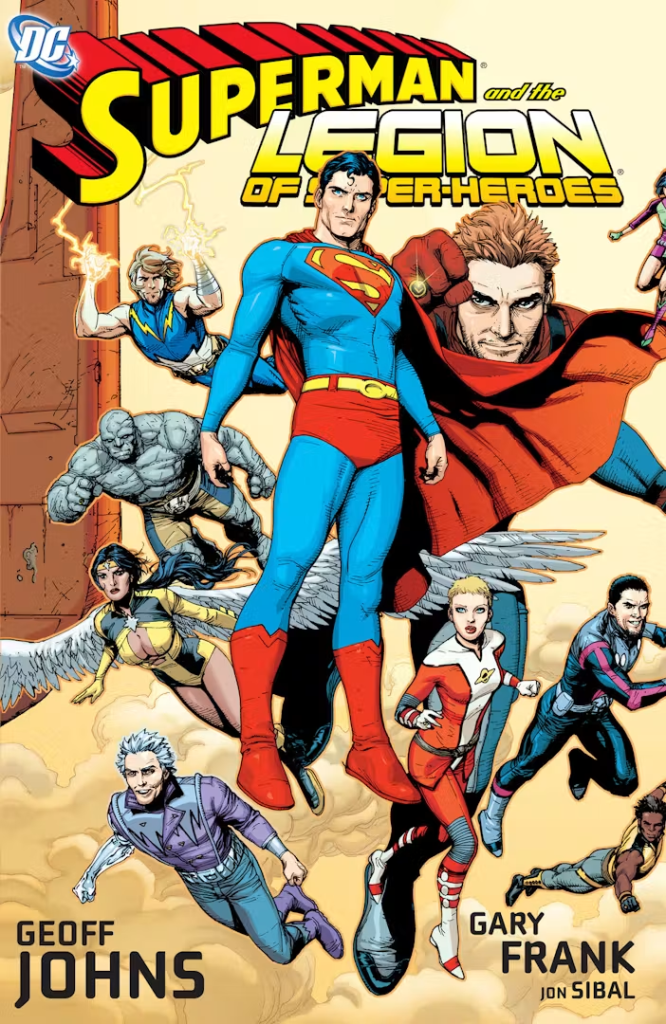
Johns’ interpretation of Superman is more of an outsider than was the standard for most of post-Crisis continuity. In Last Son he’s combative with the federal government, in Secret Origins he’s picked on as a kid, and in the whole run there’s a feeling of isolation you get from the Man of Steel.
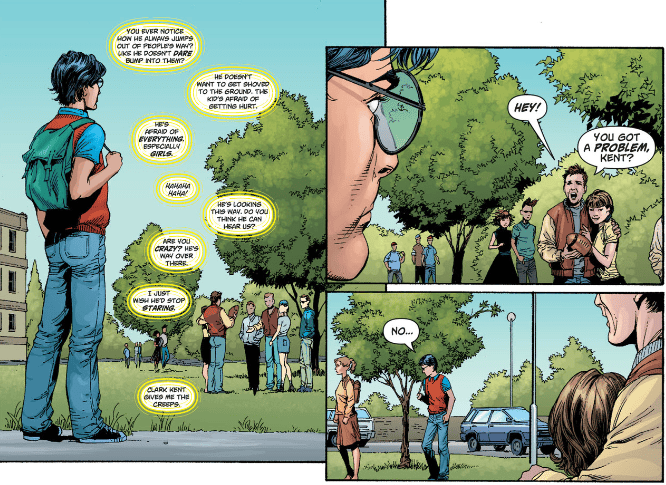
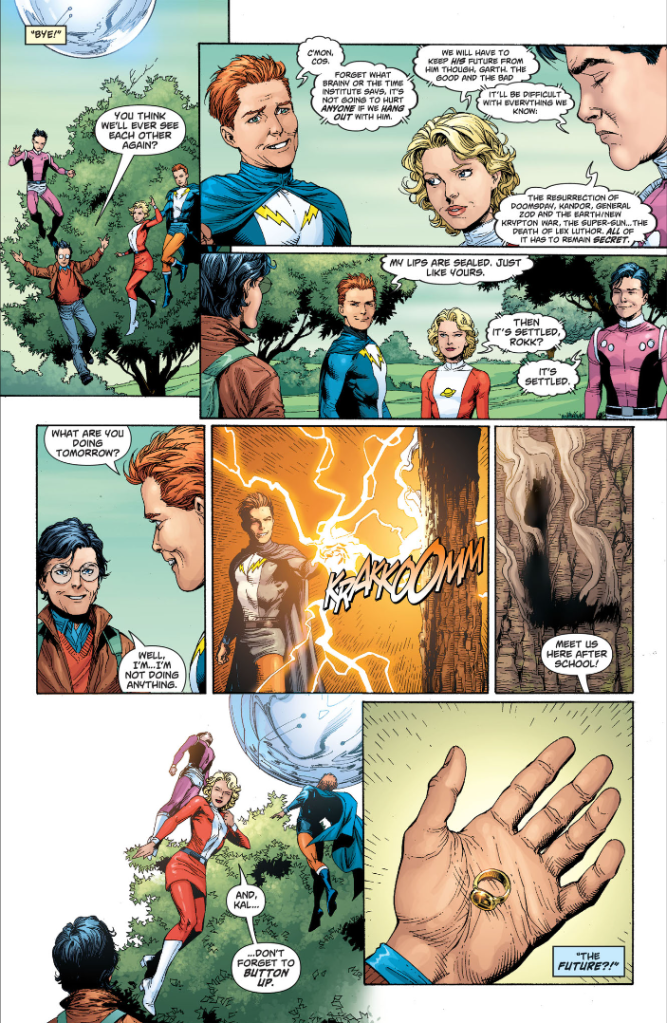
In the Legion of Super-Heroes, Superman found an answer to his solitude. The Legionnaires didn’t just look up to him but genuinely wanted to be his friend, and not some projection but the real him. From them, he first hears his birth/Jewish name, Kal-El. He doesn’t feel other-ed anymore. He can be his true self.
At risk of reading too much into it, there’s an assumption that Geoff Johns identifies with this aspect of Clark. Growing up part-Lebanese in suburban Michigan during the 70s and 80s, Johns must have faced prejudice from his peers. You can feel that experience come across the page, there’s a deep conviction but also a bite to it. It’s more than the standard fare “I feel like a loser cause I have glasses and no girlfriend,” but closer to the original Siegel/Shuster vision of the dual identity loner. Johns interprets the Clark Kent bumbling persona to be the mask, not Superman.
In Superman and the Legion of Superheroes, Johns and Frank make the most anti-xenophobic Superman comic I’ve ever read. The story has a familiar cold open, a baby boy from a doomed planet is placed in a rocket, sent off to earth, then lands in a farm in Smallville, albeit Smallville of the 31st Century. The boy’s parents remark that they chose to send him to earth because that’s where Superman is from. When an older couple come across the baby alien, they execute him instead of adopting him.
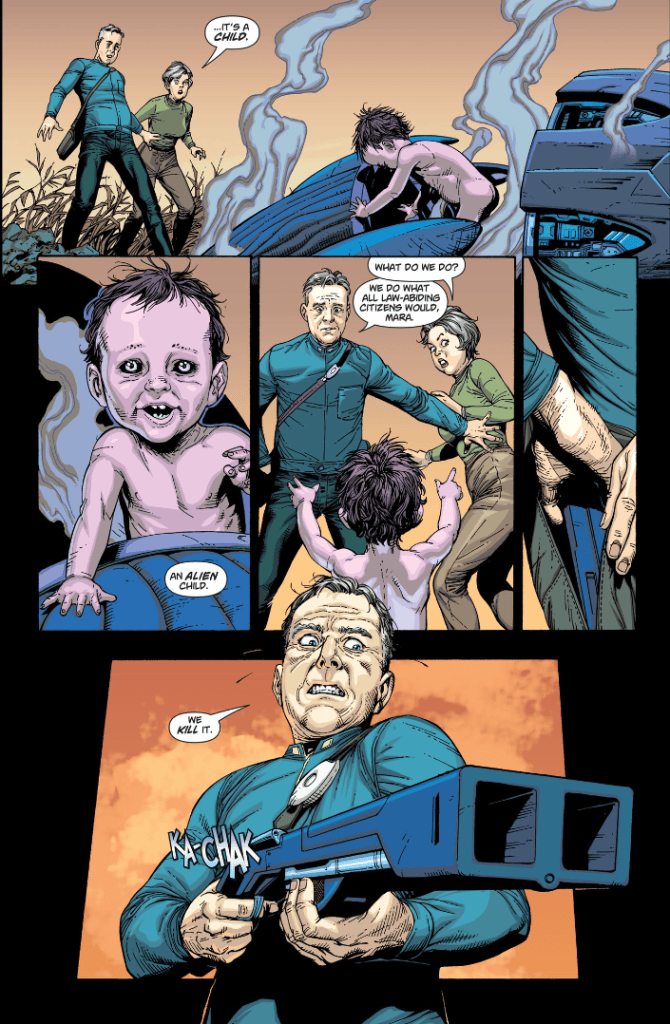
It’s dark and brutal in the Geoff Johns way of which we’re familiar by now. After all, this is the man that wrote Flashpoint. The racist couple calling themselves “law-abiding citizens” instead of the “kindly couple” of the Kents is reminiscent of Batman: Holy Terror, when the “god-fearing couple” of that world give Kal-El up to their government.
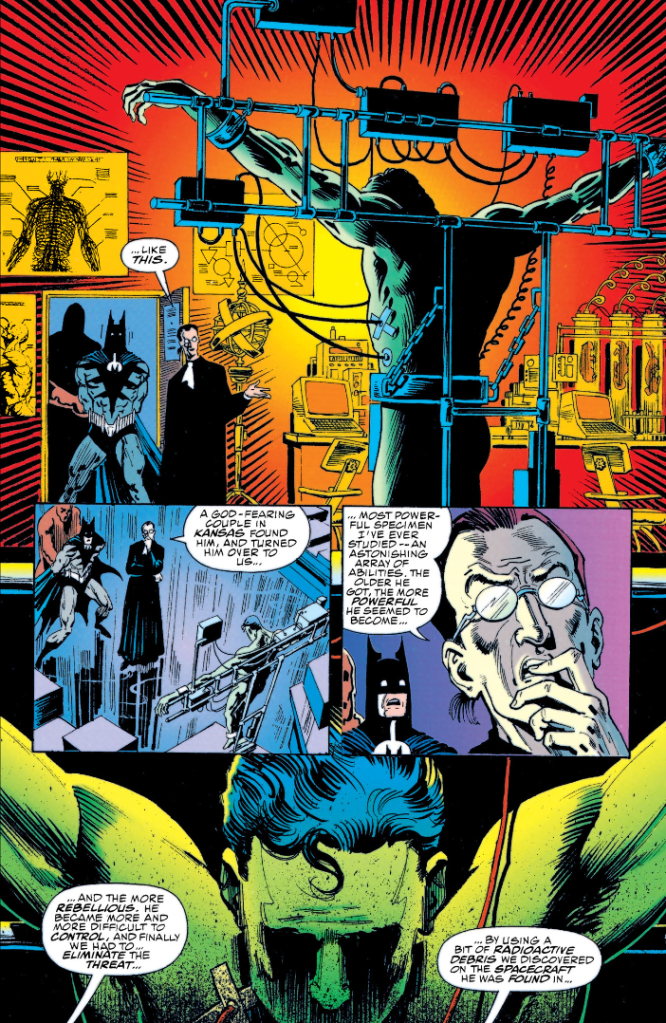
(someday, I’ll do a post about that comic, it’s one of my favorites)
After Superman is brought to the future, or the present of the Legion of Superheroes (this is the OG Legion we’re dealing with, thankfully, or else I wouldn’t be able to write this), we see the dystopia of this story is not your typical “everything is bad”- it’s one with a distinct, nativist flavor. The sun is red. Superman is shot through the hand. There’s nationalist graffiti. Some of the Legionnaires are missing, some are on the run, others are held by the dictator or in concentration camps.
The main villain of the story is Kirt Niedrigh, a Legion rejected as Absorbency Boy now known as Earth-Man. He has become the ruler of earth and leads the new Justice League of Earth. His popularity and the current wave of xenophobia in this future has been escalated by the big lie Earth-Man spread, that Superman wasn’t an alien, but instead a human born on earth.
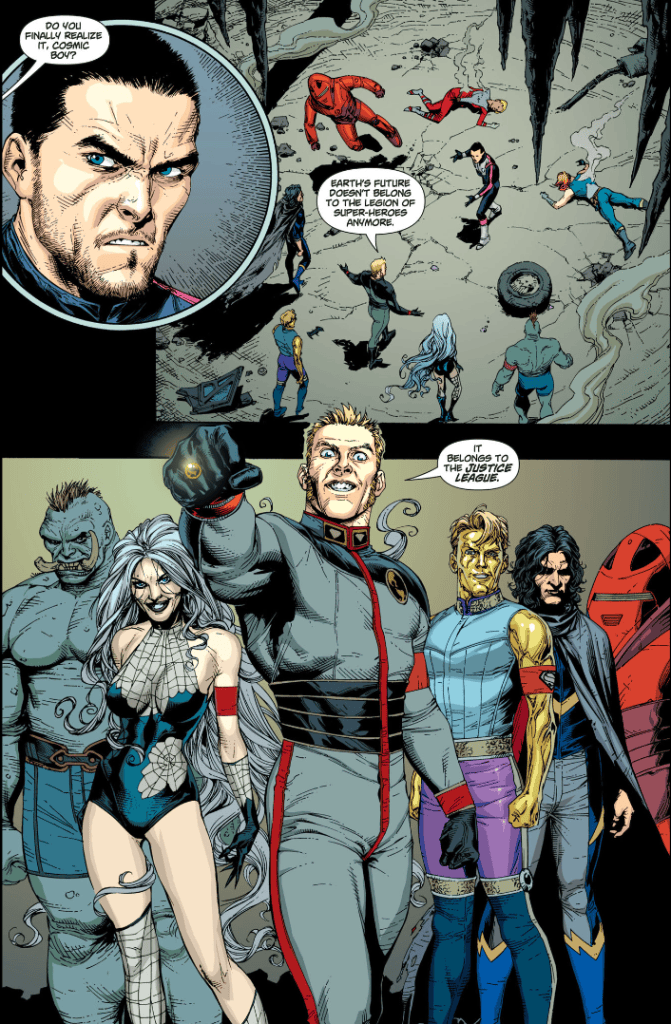
Superman being human is a lie reminiscent of birtherism. This comic predates the popularity of that conspiracy theory, but as I talk about all the time, it feels like writers predict the future when they’re actually just well-read.
Johns uses this story alongside Secret Origin as an indirect refutation of the nativist overtones of John Byrne’s MAN OF STEEL origin. Byrne is a noted xenophobe, homophobe, transphobe, and scab. His 80s Superman origin story retcons that Kal-El was not really born on Krypton, but instead sent as biological material from Krypton to be birthed upon arrival so that he could be a “true American”, instead of an immigrant or alien.
Like Byrne, Earth-Man seeks to rewrite history to fit the narrative he wants to set, that Superman is not an immigrant. Niedrigh and Byrne know this is not the reality, but they don’t care. They are bigots and ideologues, never getting over a feeling of being outcast as a child, so they spin their lies into reality. Niedrigh gives him a fascist-looking uniform, but nobody follows suit. He surrounds himself with other losers, all rejected from The Legion as much for their dangerous personalities as their powers, who themselves likely rejected the Legion of Substitute Heroes because they thought it was beneath them. So now they lash back against The Legion, a diverse group of individuals, most of whom are aliens, so they can feel superior. Those who decry “forced diversity” just think they should be the ones with all the fame and power.
The villains call themselves the Justice League of Earth, claiming a legacy that is not their own, just as the Nazis claimed the legacy of the Romans. (Not that the JLA was like the Roman Empire, but you get the reference.) The corruption of Superman symbol for xenophobia/war evokes the corruption of the flag and patriotism for nativism and the war on terror, alongside the corruption of countless other symbols throughout history. The fascists, in this reality like our own, have no imagination. They have flight rings too, just with an S symbol instead of the L. They can’t come up with a name for themselves, so they call themselves the Justice League of Earth. The bigots rallying cry, “Earth First” or “America First” isn’t even original. It’s almost a century old now.
The Legion of Superheroes is an interesting choice for this type of narrative. They’re not as clearly a metaphor for social justice warriors as much as X-Men or outsiders as much as the Doom Patrol, but they do have a diverse cast. To me, a lot of the core of The Legion is about radical acceptance. There are so many people from alien races that look so distinct, so many lives lived that are beyond the imagining of anyone else, that it kind of has to be about that sometimes. Braniac 5, a descendent of actual Braniac, is one of the core members. So is Lightning Lad, whose own brother is a supervillain.
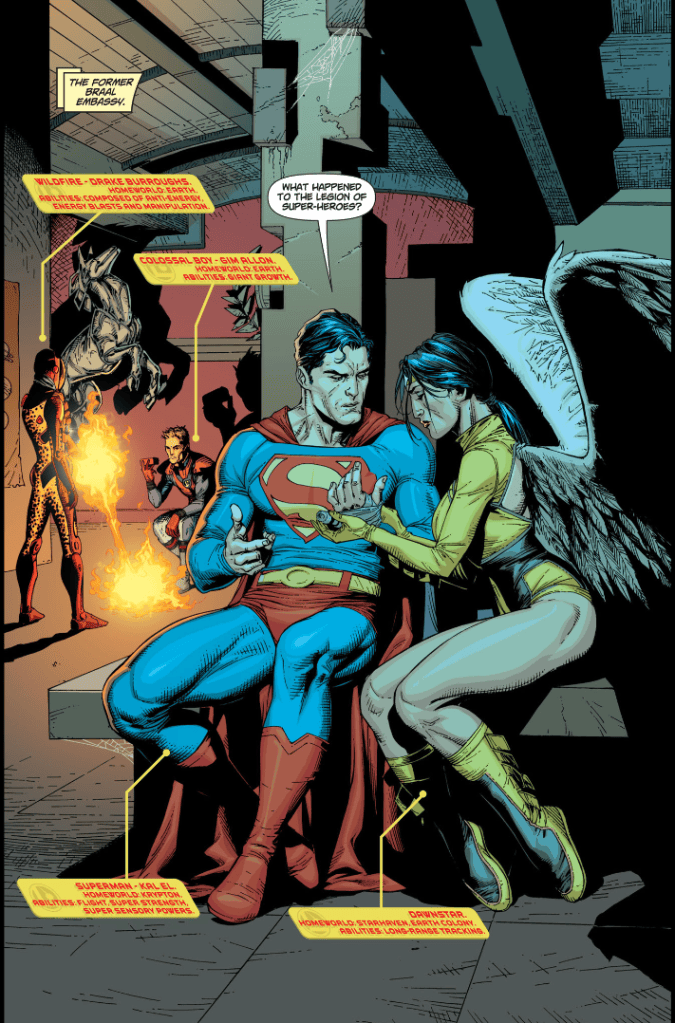
There’s a lot more that I could write about this story, but we’re at a lot of words and I want to work on other things. I think people should read this comic, and I feel bad about giving away the ending to We3 last week, so I won’t spoil the rest of the plot. Gary Frank’s talent is on full display as he nails the big establishing shots, action, and iconic imagery. Sibal’s inks and Anderson’s colors are on point, complimenting Frank’s pencils perfectly and helping make a book where so much is happening clear and good looking. There are small nitpicks I could write about, but they don’t matter. It’s a very good comic.
I love both of these comics. They play to Geoff Johns’ strengths: simple stories, high octane action, and blunt political messaging. He hits you over the head with the metaphors, and it works. In 2026, the satire of days past doesn’t hit the same, not with the bumbling authoritarians beating their chest every day to show us how awful they are. Sometimes we need a story that affirms that we’re not crazy about how bad things are, and we’re not crazy for seeing those patterns emerging decades ago. Sometimes we need a story that tells us that we can make it out, that we can come together and beat the fascists.
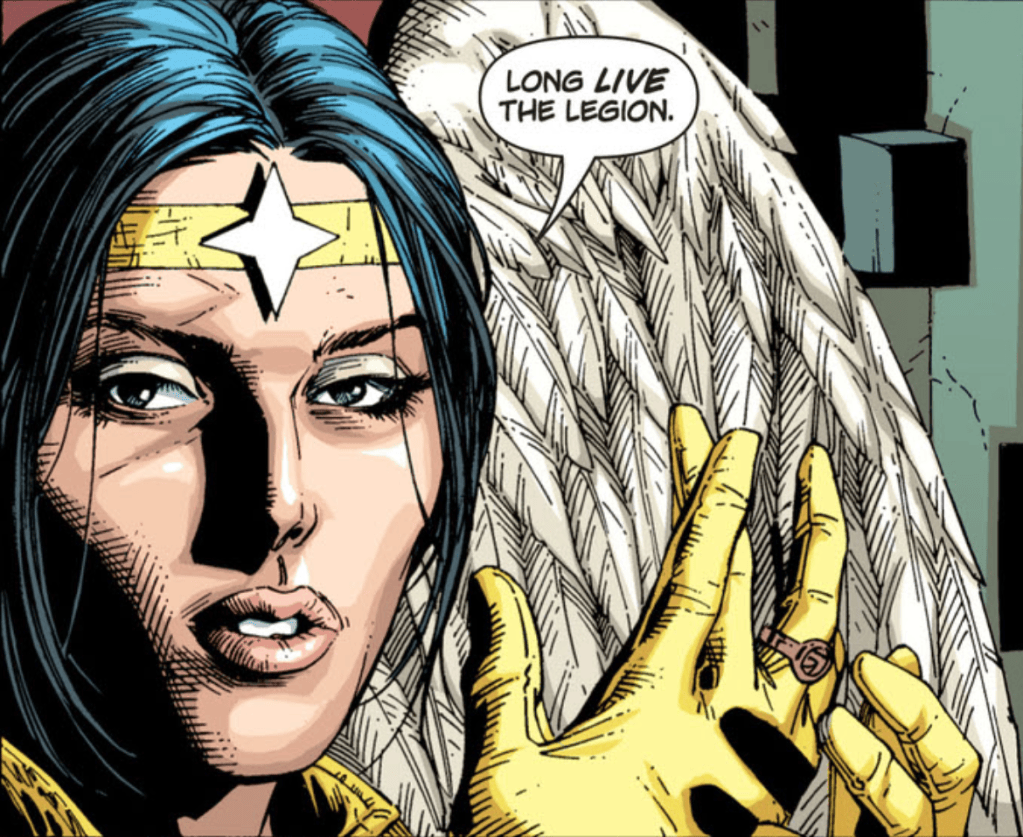
LONG LIVE THE LEGION!
the the extra:
This is the first essay in a series I’m doing called “A Lukewarm Defense of Geoff Johns”, about the writer we as a comics reading public have dismissed over time because of the large scale changes he made at DC (and some that weren’t his fault). I believe he is a fascinating creative voice who, at the end of the day, is a good writer, even if we don’t like the outcomes of his work. Later on, we’ll get to the controversial comics and the hubris that doomed him.
Please feel free to leave a comment! I’ll try to respond to them, there’s little I love more than talking about comics.
If John Byrne has no haters I am a dead enby.
Song recommendations: La Jura and Invisible People by Chicano Batman, Sad Boys by Dazey and the Scouts
(I did more than one recommendation for this post because this is a long one and I think all three are relevant.)
If you want a deep dive on what Callisto and Magneto’s ideology mean to the X-Men, I’d recommend the Callisto, Magneto, and Professor X episodes of Connor Goldsmith’s Cerebro podcast. The guest for all three of those episodes is Spencer Ackerman, an individual whose work is discussed and recommended in a prior post.
This one is long and took a long time to write, sorry about that. I read and reread a bunch for this, much of which I didn’t use, but this is also a tough subject. I’m working on a longer piece about Lanterns, but I’m going to do some shorter posts before that.
ABOLISH ICE, ABOLISH DHS, DEFUND THE POLICE, FREE PALESTINE


Leave a comment