The Subversive Queer Coding of Joker in Death of the Family
Scott Snyder is one of my favorite horror writers, having penned such masterpieces as Wytches, Night of the Ghoul, Dark Spaces: Dungeon, and Book of Evil. He has a unique voice and an uncanny proficiency in bringing those horror chops into his cape comics, most notably with his Joker.
In collaboration with Jock, James Tynion IV, and Jonathan Glapion in Death of the Family, Snyder and Greg Capullo construct a Joker that is utterly terrifying. He’s an almost supernatural horror, inconceivable in his wickedness and with a presence that is felt even more when he’s not on the page.
The story starts off with a rainy Gotham, as Jim Gordon talks to Bullock off-screen about all the omens happening recently, like a Lion giving birth to a two-headed cub at the zoo and the river running backwards. As the audience we know this is an omen to Joker. (If you were reading it at the time, you would have seen the Death of the Family arc title on issue #12, a reference to Death in the Family, the arc where Joker killed Jason Todd. If you’re reading it after the fact on the trade, you see the Joker’s stapled on face as the cover.) This is where Snyder starts to play into the supernatural elements of the Joker, a recurring theme across his entire tenure on Batman.
The first time we encounter Joker is played like a straight up horror scene. You see a partial joker in the background, and then just Gordons reaction to him with the pinpoint pupils. It’s a play on the “don’t show the monster” tenet in horror movies, but we already know what the Joker looks like so it works to show a creepier slice of him. Think of the Xenomorph in the first Alien movie. We don’t fully see him until the very end, and the small parts of him we see only increase the effect.
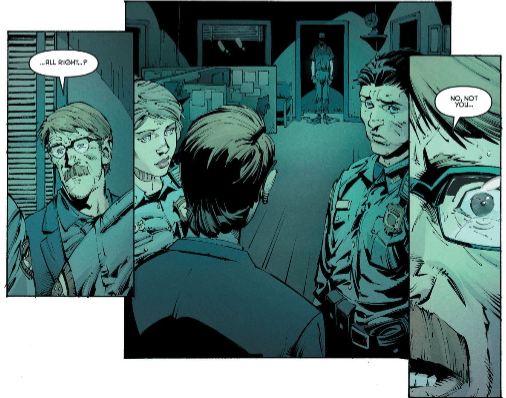
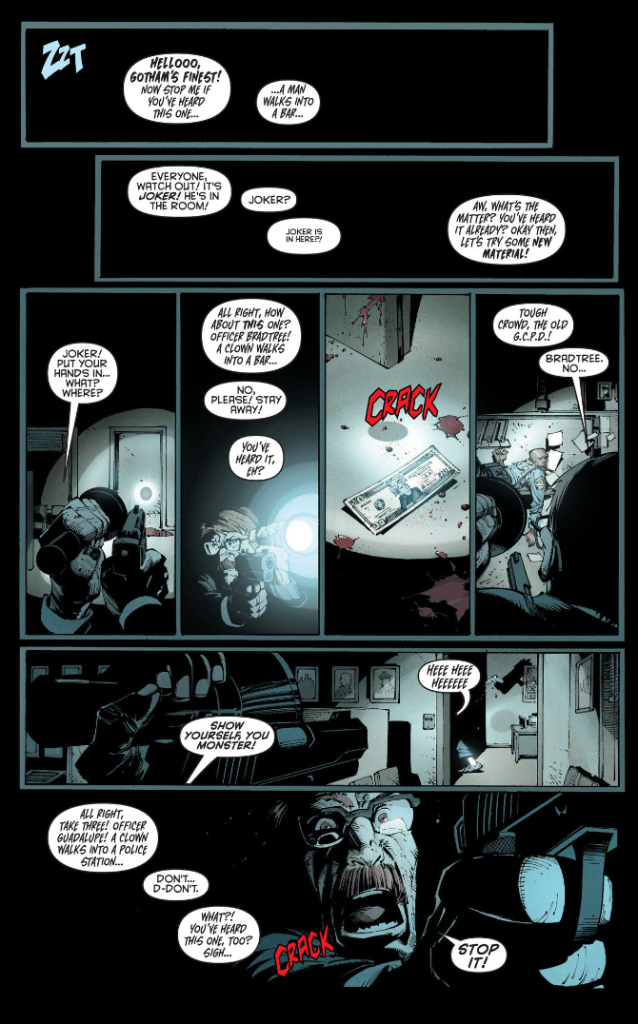
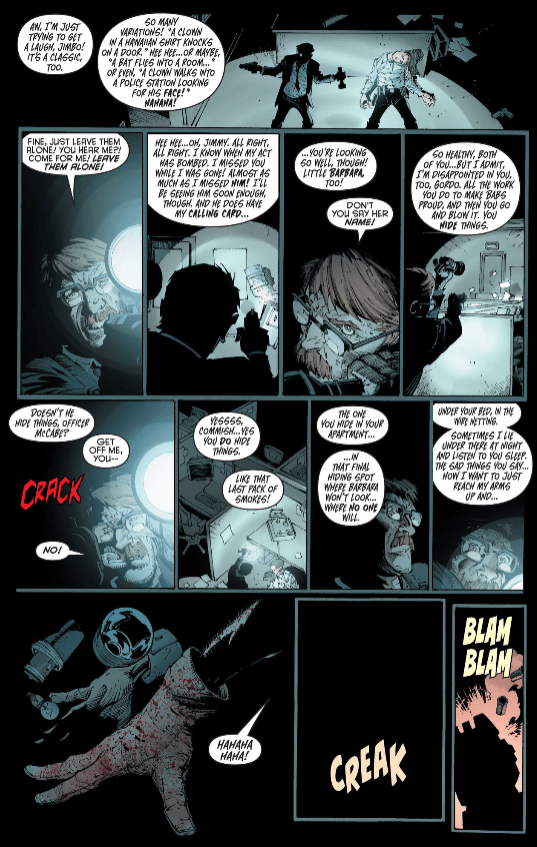
The lights are cut out and the majority of the next two pages are in darkness. We only see Joker’s foot and the destruction is created. Instead of telling a joke, he tells Gordon all of the things he knows about him that he shouldn’t like where he hides his cigarettes. He even builds this portrayal as a horror monster himself, talking about hiding under Gordon’s bed at night.
In an October 2024 interview with Casually Comics, Snyder described his approach to Batman as asking “what is the thing I’m afraid of or hopeful about? How do I build a story out of that Batman can engage in?”. On the Joker, he said “I’ve always enjoyed him for his terror.”
I’ve always thought that Joker works best as a serial killer, from his introduction in Batman #1 by Bob Kane and Bill Finger to his reinvention by Neal Adams and Denny O’Neil in Batman #254. He kills people because it’s fun for him and because he’s got this twisted sort of philosophical nihilism. The media frenzy and American cultural weight of serial killers in the 70s and 80s fueled the rise of slasher horror, because that’s what we were afraid of as a society.
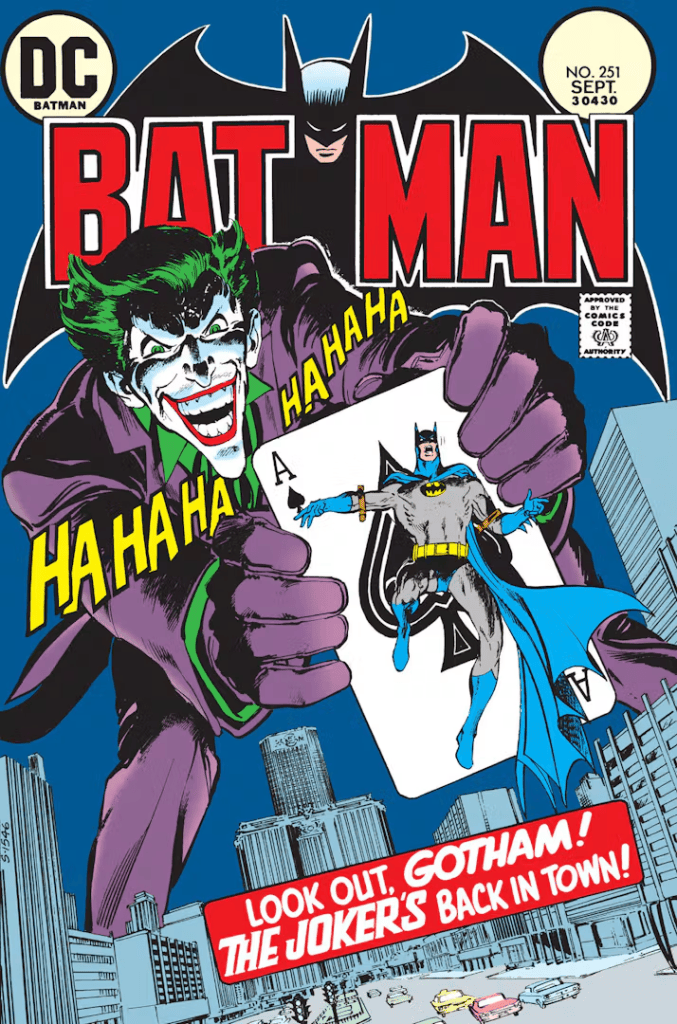
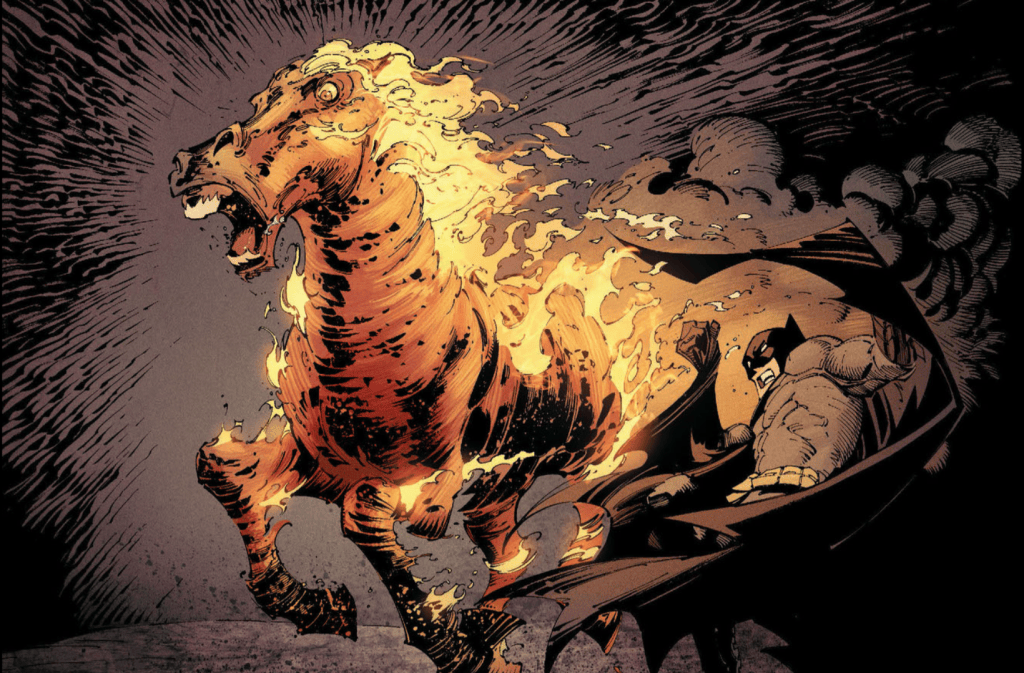
There’s a theatricality to Joker’s methods. He announces his crimes, he makes people laugh to death, he dresses in ridiculous suits. He doesn’t take the easy way, partially because that’s not scary. He’s skinny, and he’s usually not portrayed as a particularly effective fighter or gunsmith, so he needs his reputation. In Death of the Family, he uses his theatricality to build up himself as a horror villain. His effectiveness in scaring Batman and Gordon and everyone else is enhanced by this, he staples his face on poorly and comports himself in the way he does because he knows it’s scary. Lighting a horse on fire is not an effective way to kill someone, but it is a way to scare someone. (It also just looks cool. Greg Capullo did draw Spawn for a long time before this, after all.)
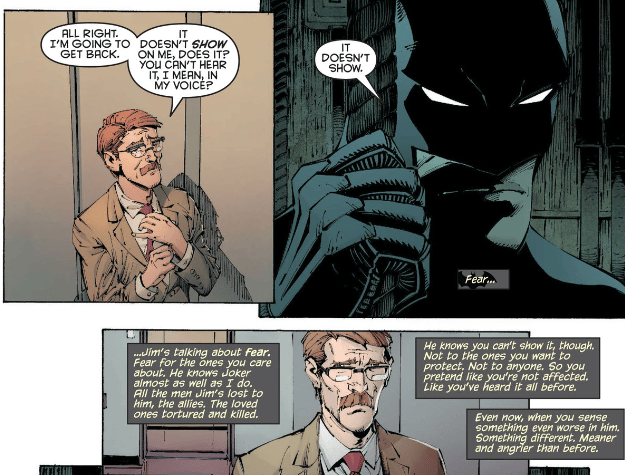
Another facet of this story is talking about how to deal with fear as a parent or authority figure. Batman and Gordon have a long history with the Joker’s terror, but they have to keep up a veneer of calm to try and keep everyone else from going nuts.
He announces his kills like the serial killers, although the Zodiac Killer never said who was his next target. Here we find the major difference between Joker and the typical monster or serial killer: his obsession with Batman.
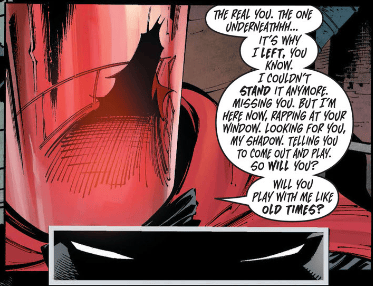
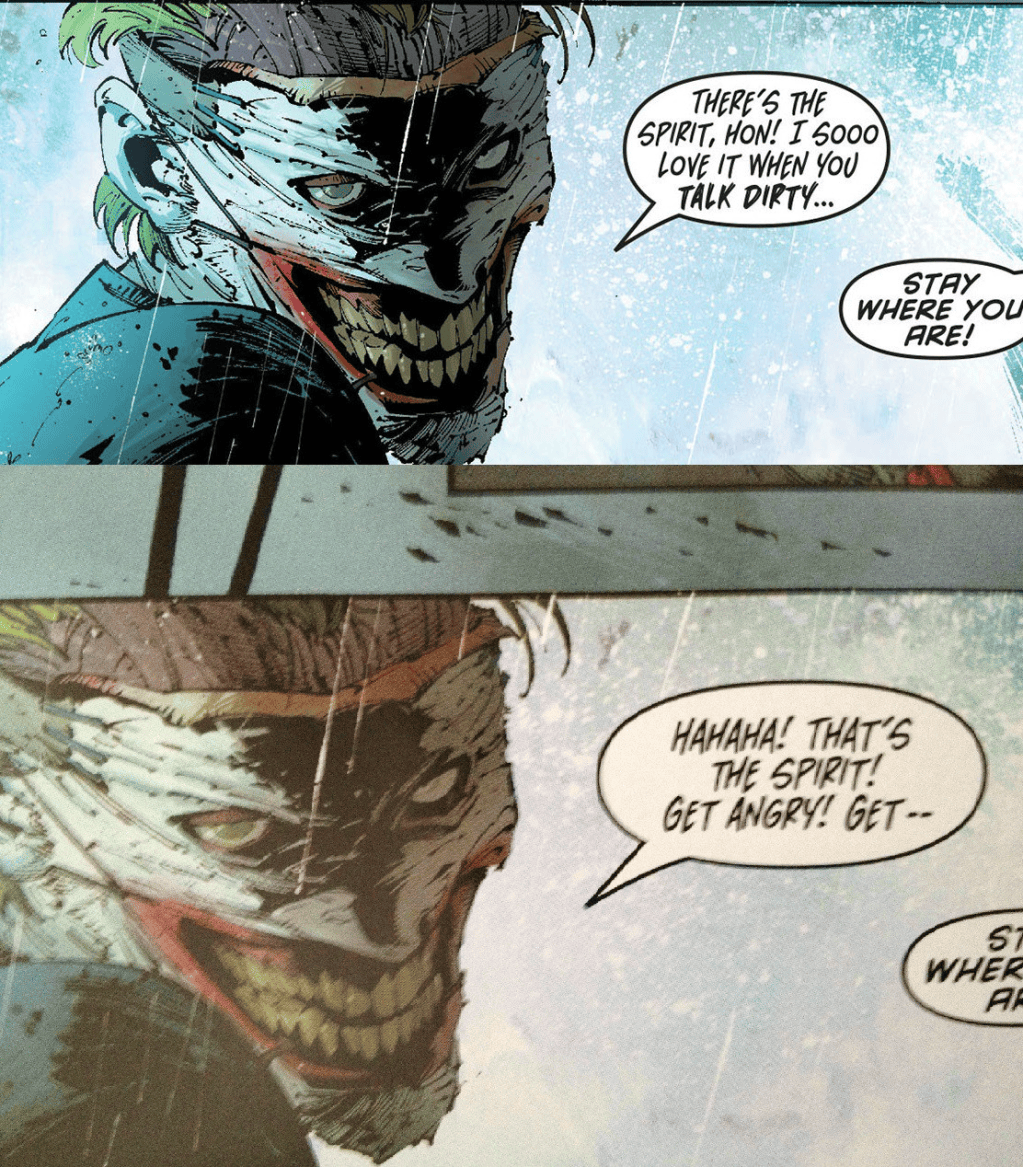
There’s something romantic to it, and this is in no way a new observation. Joker’s pupils dilate when he sees Batman and he keeps coming back again and again just to fuck with Bruce. Joker calls him “darling” and “old friend” (the latter like Magneto and Professor X, who are also a metaphorical couple). There’s also a definite gay-coding to the way he carries himself.

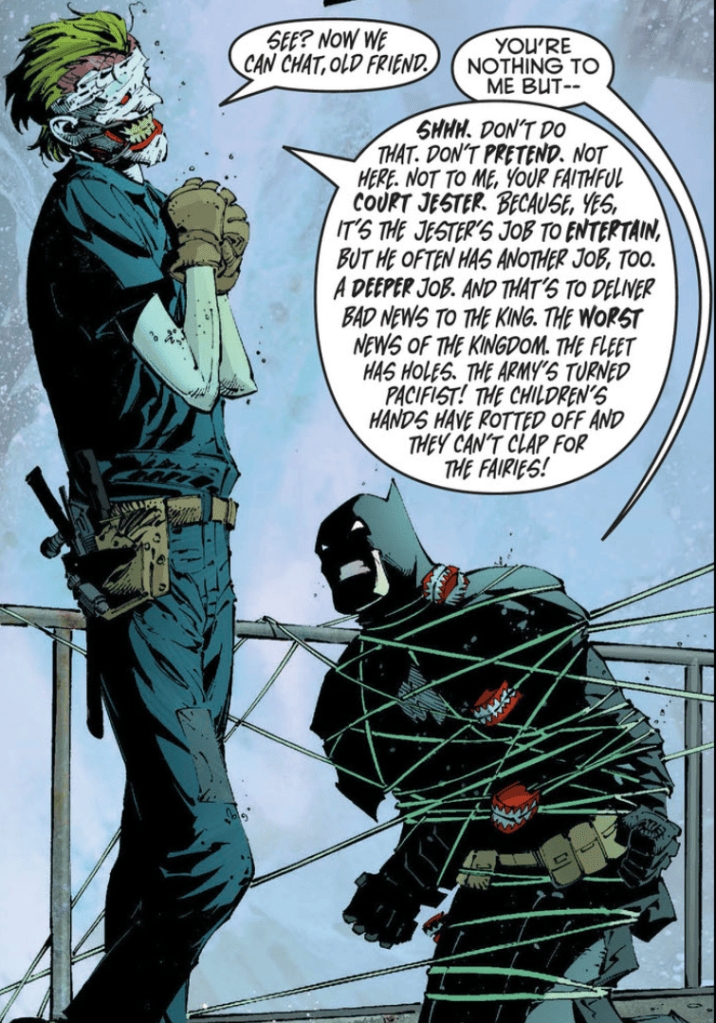
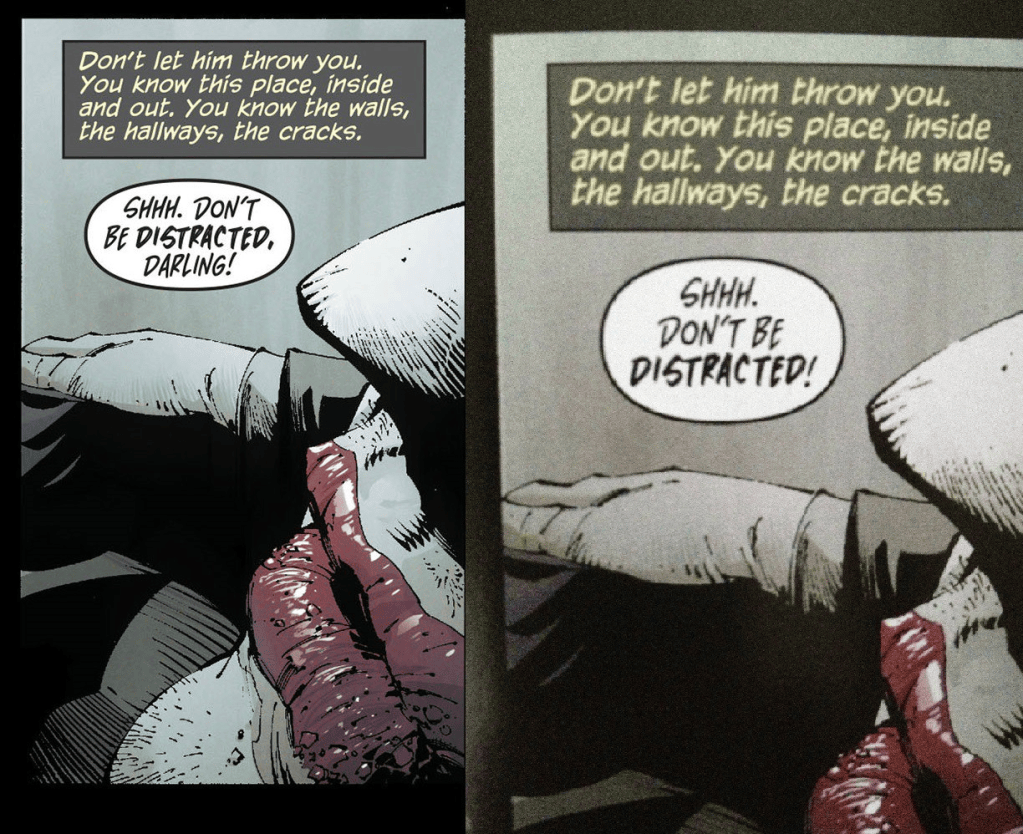
There’s even a few lines either editorial or Snyder himself cut out for the trade wherein Joker is extra flirtatious. There’s a couple sex jokes and more “darlings” cut out. But even without those, the subtext isn’t exactly subtle.
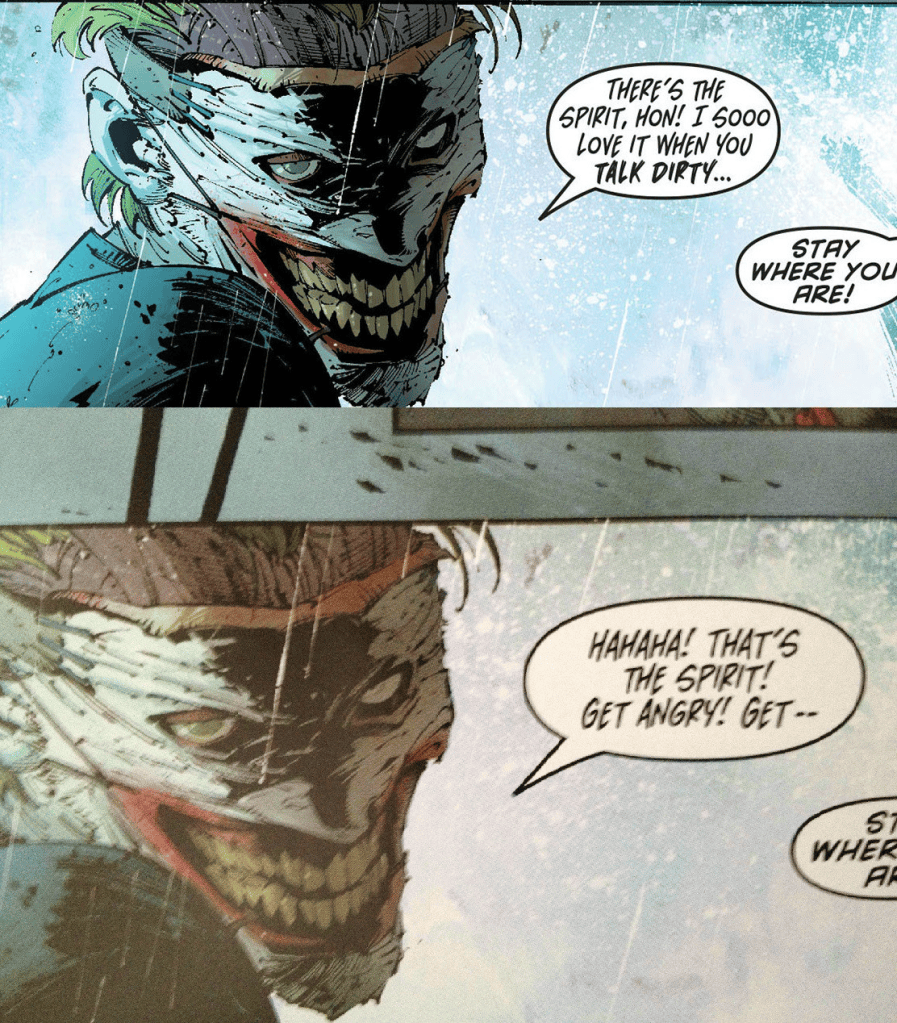
(thanks to u/RaffNav on reddit for pulling these)
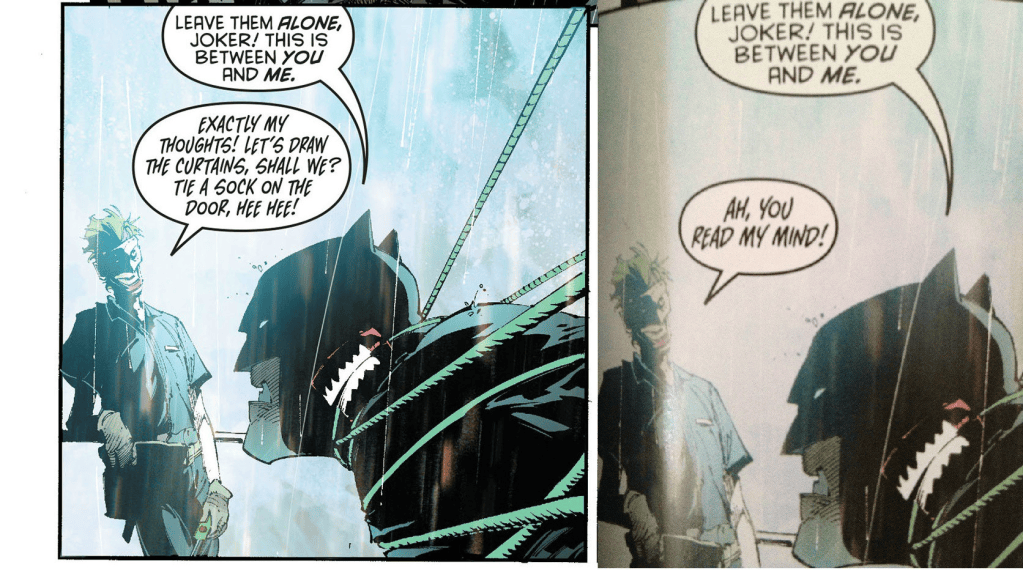
Without even getting into it, “ah, you read my mind!” is just a much more boring line.
This portrayal is a controversial one, and it’s not new either. From DKR and Arkham Asylum: A Serious House on Serious Earth to the Lego Batman movie and the “you complete me/you’re garbage” from the Dark Knight movie. There are numerous thoughtful video essays you can find about Joker and queer coding, often in a negative context. For the most part, I agree with them.
This is something we all know but is worth repeating because it gets pushed to the back of gay stereotypes nowadays. I’ve even seen young, straight comedians use “why do we call it homophobia, gay people are the least scary blah blah blah” as a cheap joke. Perhaps the most harmful stereotype about queer people and especially gay men is that they are inherently sexually dangerous because of their/our queerness.
There definitely is a trope in popular media we’ve all seen where villains are queercoded (think of all the Disney movies), and some villains are seen as dangerous because of that queerness. But clearly, that is not the only thing going on here.
In the same interview as above, Snyder was talking about how he approaches horror stories by tackling things he’s scared about in life. “Death in the Family is the Joker literally come to Batman and being like ‘you don’t really want a family, you just want to go back to me and you. You want to be young again and it be the two of us and we do this forever without any of that. And that’s a straight up horror story,” a reflection, he said, of his insecurities about his family and job at the time. It was the same feeling accessed when writing Wytches.
Playing on that, there is a running question in the plot as to whether Joker knows Batman’s secret identity. Partly because he says he does, but of course, you can never take Joker for his word.
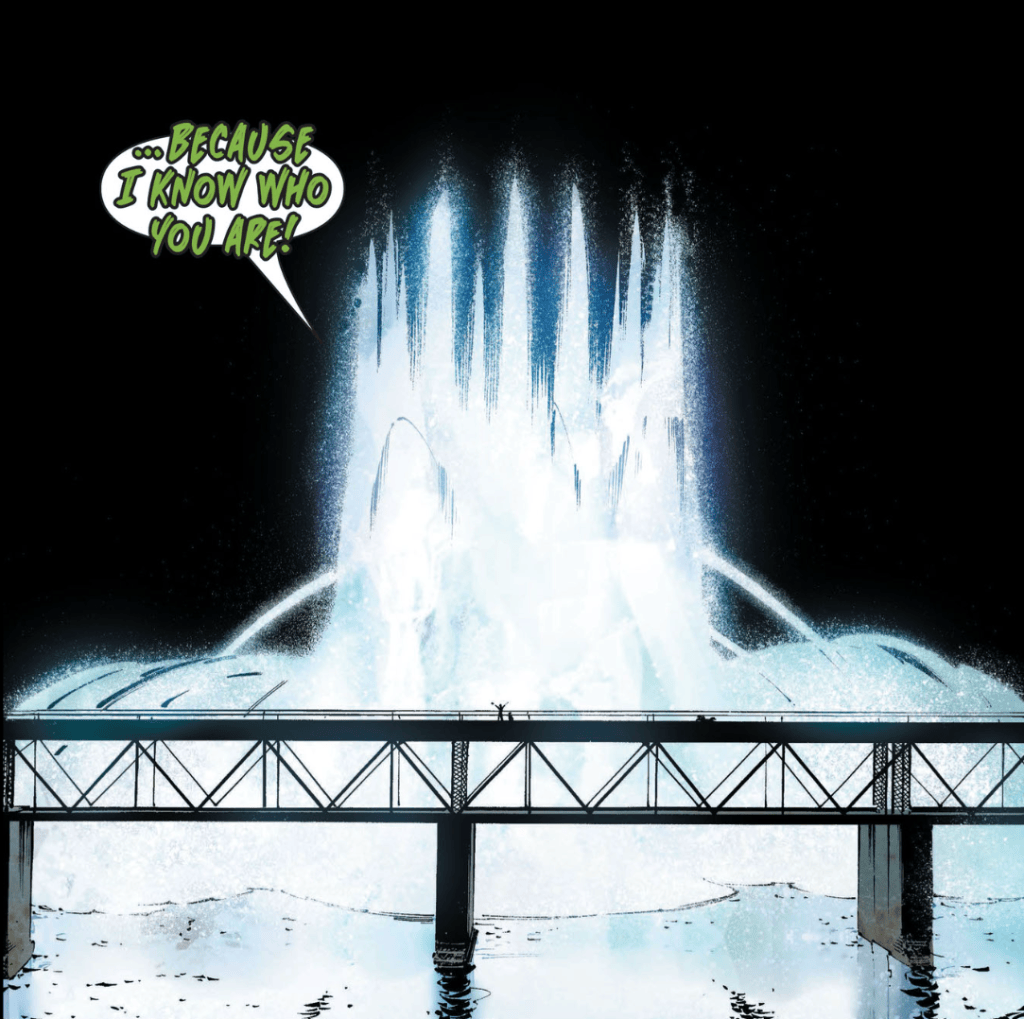
(Off topic but I love this panel. The zoom out, small figure of noticeable acting of the Joker the bridge and the coloring is perfect. This is also a good example of “lettering doesn’t have to be invisible” as the placement of the word balloon with the large green font exceeding the lines is a great choice.)
The other part of the mystery is one time that Bruce found a joker card in the Batcave, some place where Joker couldn’t have placed it without knowing where he is. This “does he know my identity” is a meaningful struggle throughout the story, as a villain in a superhero story always means bad news for a hero and his loved ones, especially for someone as vile as the Joker.
But at the end of the day, Joker doesn’t care who Batman is. He’s delusional in his obsession and can never even recognize Bruce as a person. This is highlighted when Bruce visits him in Arkham Asylum at the end of the story, and the pupils are no longer dilated. He doesn’t recognize the human side of him.
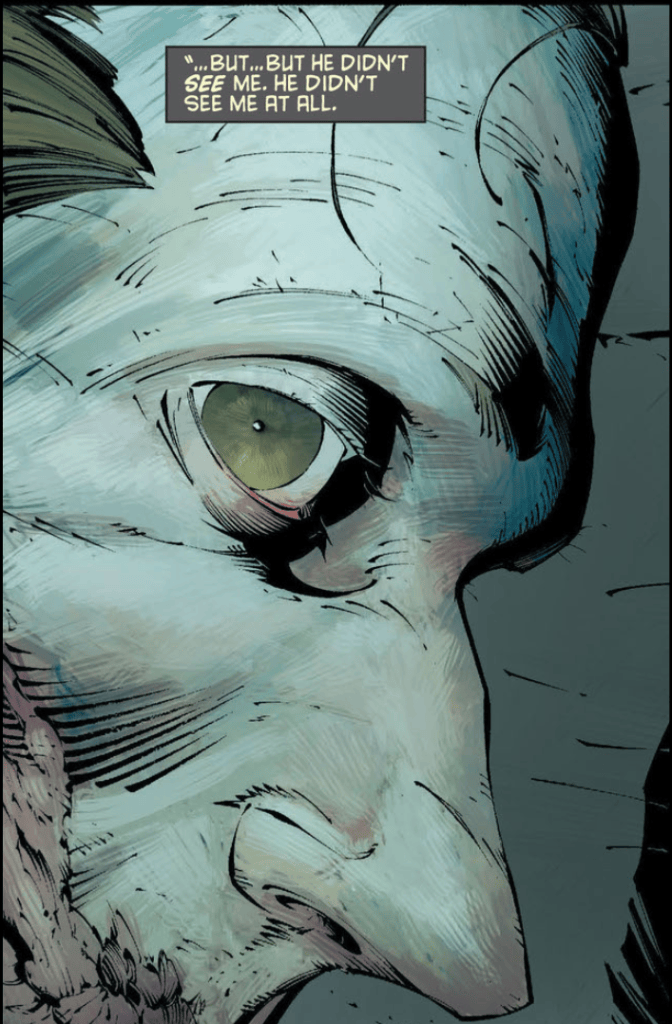
I’ve seen a lot of takes on this. Sal from Comicpop thinks this version of Joker doesn’t sit right with him because he sees Joker as asexual. I’ve seen another take (I think it was from @waitingforthetrade.bsky.social on Bluesky or PandaRed on youtube or both) that this portrayal of Joker is in character, he’s not actually gay or in love with Batman, he just does it to fuck with him. This is the version of the character that makes sense to me. I also think that is what is happening on a meta level; Snyder is using this as a ploy to make us think about Joker. Just how the theatrics of Joker presenting himself as a horror villain is all an act, the “darlings” and sex jokes are an act. It’s more of the Joker building himself up.
It’s supposed to scare us because it’s a horror story. Snyder is no homophobe but he’s also not Jane Schoenbrun and this isn’t Camp Miasma. Stories like Dark Knight Returns portrays it as more of a sort of fate destined romance, but that just doesn’t fit here. There’s not even a real attraction. Joker doesn’t find Bruce physically attractive and doesn’t want to have sex with him or anything, it’s just plain obsession. It’s all a game to play with him.
The point of the story is that Batman has to prove that he doesn’t actually care about Joker. He cares more about his family than he wants to be Batman. Batman isn’t a curse, it’s something that he does because he wants to keep people safe, and he recognizes that entertaining the Joker is only ever going to hurt more people.
At the end of the day, I don’t know if Snyder pulls it off. It works for me and I’m certainly not offended, but I don’t know how it affects the public at large. Being gay doesn’t make you dangerous, and I think there’s enough to reinforce the fact that it’s not the possible gayness of the Joker that makes him dangerous, but the obsession and lack of care for others.
Edited by Tiffany Frost
The the extra:
Song recommendation: F**k You by Lily Allen and Your Woman by White Town
Massive shoutout to Casually Comics, she’s a great interviewer and her whole channel is great, probably my favorite on youtube.
I mostly talked about Snyder and Capullo here, as they were the main writer and artist. Jonathan Glapion’s inks and FCO Plascencia/Tynion and Jock need a shoutout for their work on the backups. This whole team is phenomenal.
I’d also like to thank my good friend and former roommate Liam for the idea of this story. We used to spend a lot of nights watching movies and especially talking about them. As he’s started his descent into comics nerddom, it’s been great being able to
Thank you to my good friend Tiffany Frost for serving as editor and helping me with titles.
There are of course a lot of other times Scott Snyder played with the Joker. I might do one about those later because I wanted to keep this one more focused.
I said I was going to do an essay about The Department of Truth, but the draft I had was a total mess. I figured out a better angle, and I’ll get to it eventually. I’m watching Clayface tonight and might do a review of that.


Leave a Reply