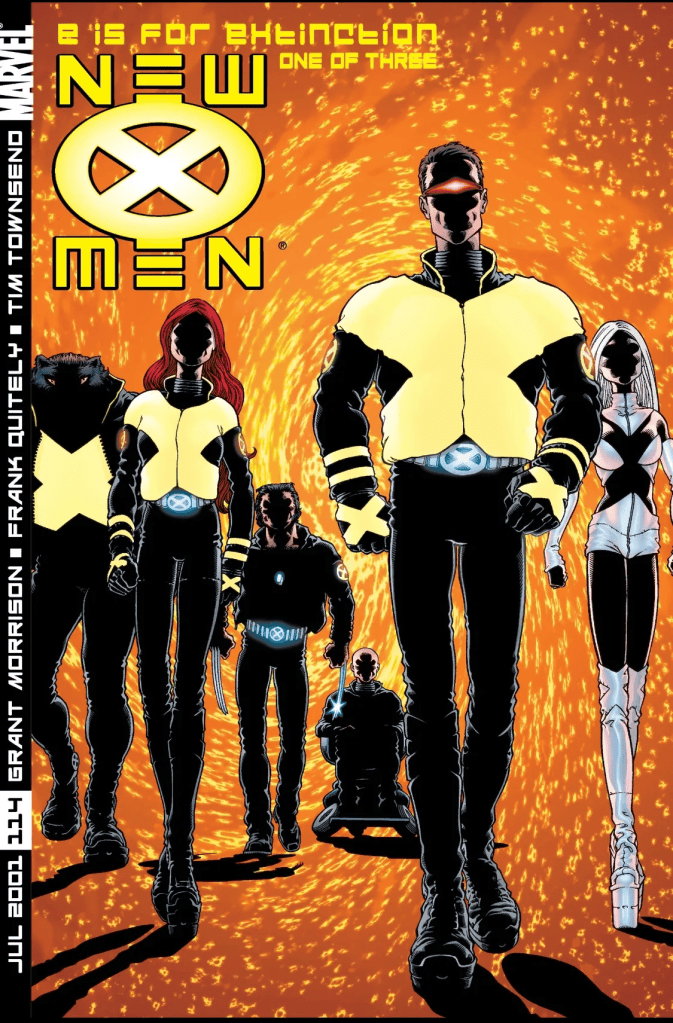
I started a reread of New X-Men recently, having an extra-long essay in mind I already planned out and wrote about 1,000 words for. But as I’m reading, I just have SO MANY thoughts. These aren’t going to be essays, just stream-of-consciousness thoughts and analysis here and there.
I’m a huge X-Men fan (by my count I’ve read somewhere north of 600 X-comics) and Grant Morrison is my favorite writer, so it’s no surprise that I love this run.
(This post will contain spoilers for the first arc of the run; E is for Extinction.)
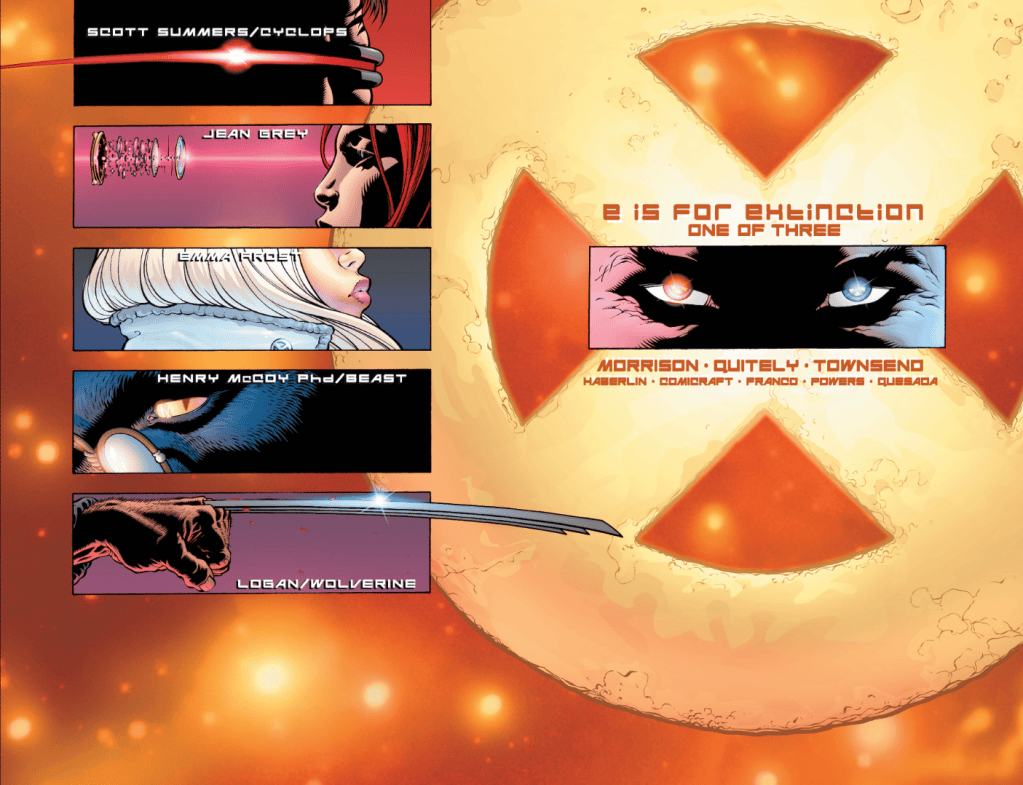
The first, most obvious thing is how cool the looks in this series is. Quitely is a master, and it’s going to be hard not to talk about how great every page is. The designs are slick, more sci-fi than superhero. The black leather is like The Invisibles, The Matrix, and the new (at the time) X-Men movies. As they put it in Supergods, Morrison set to replace the superhero and paramilitary aspects as “a Gerry Anderson-style emergency task force”, hence the “rugged municipal worker outfits with fluorescent X logos” they and Quitely designed.
(I’d like to make a clarification and say that, largely, when I’m talking about aspects of art like composition and character design, I’ll likely include Morrison for credit. They oftentimes design characters/costumes themselves as they put a lot of thought into costuming, and in Supergods did directly state that they designed these costumes with Quitely. Additionally, since Morrison first came up as a writer/artist and is very particular about how comics look, they also typically draw thumbnails or loose layouts. I never mean to diminish the artists, who still do all of the actual work of turning words into pictures.)
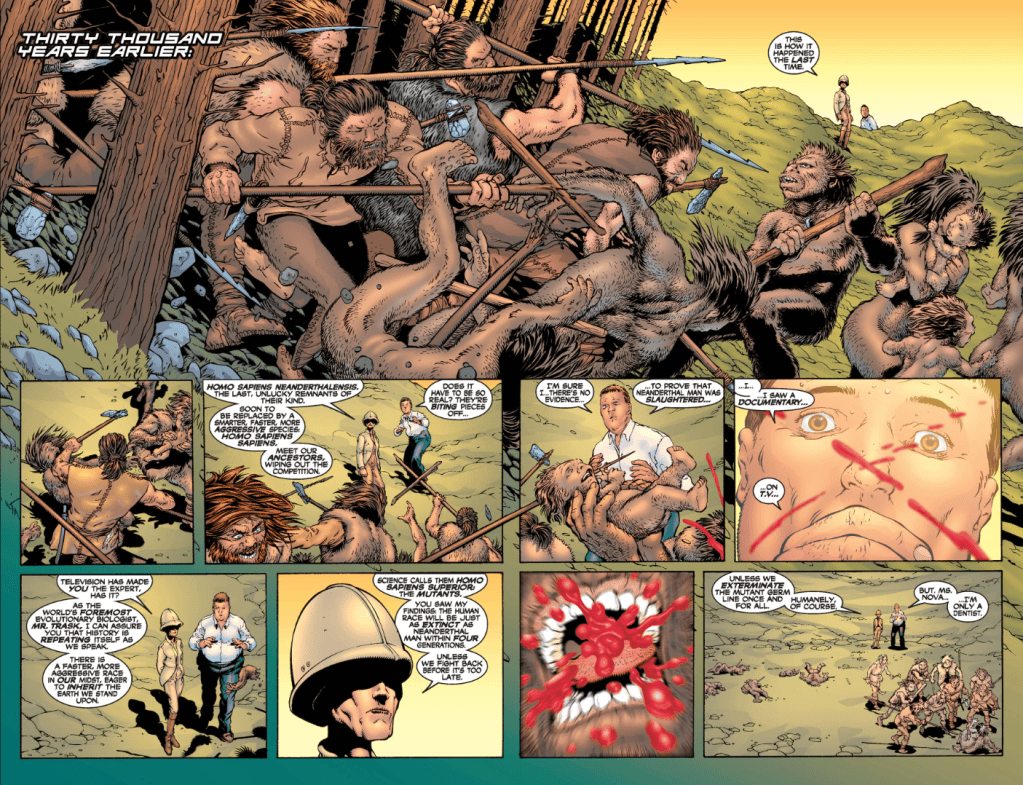
There’s a lot to be said about Cassandra Nova, and I’ll get into more of it as this continues. This page is a great character introduction to her, giving small details that tell you a lot more about the character, something Morrison excels at. There’s shadow over her face, she’s wearing colonizer attire, and the first thing she says is a lie. The neanderthals weren’t the victims of genocide by our branch of humanity; they just went extinct in the less dramatic ways most species do. See this explainer from Nature, or these from The Smithsonian’s website and magazine.
I think an aspect of Morrison’s writing that can fly over one’s head (it admittedly did to me at first) is that his characters will casually lie somewhat frequently. In big 2 cape comics this is somewhat of an anomaly, as when characters lie it’s either in service of a twist or a lie with other text to show you it’s a lie. With attention, alongside knowing how their writing and sense of humor works, it’s not difficult at all to pick up on the Morrisonian fibs.
Nova tells this Trask that humans will eventually be replaced by mutants, one of the main premises to the whole run. We find out that this is not a lie, Hank McCoy makes a similar observation, but it’s not how Cassandra Nova presents it. There is no prophecy that all of the mutants will kill humans, that there’s something built in nature. It’s peaceful. More and more people will be born mutants until nobody is born without the x-gene.
This is one of the parts of the run I’ve got the most complicated feelings about, as I think it mixes the Mutant Metaphor somewhat. Morrison’s view of the mutants is of general outsiders, a slight but meaningful contradiction to the more popular take that they represent (insert oppressed people here). If you take the “replacement” somewhat more literally and with the later interpretation of the Mutant Metaphor, then you get into a sort of “great replacement theory” territory that is not a fun place to be.
I’m sure Grant Morrison doesn’t believe in that, it can be interpreted to be about the death of monoculture, that eventually we’ll all become outsiders or whatever.
X-Men is a franchise notoriously mired in continuity, with no reboots and a return to “status quo” not always guaranteed. (I think this is a good thing, the lack of a reliable status quo means that X-Men operates more easily as a singular narrative than, say, Spider-Man or basically any DC character. Hell, Legion of Superheroes is on its sixth reboot right now and it’s very frustrating.) So, if you ask most intense X-Men fans where good starting points are, nearly all of us will say Giant Size X-Men #1 and not even give an alternative. You can give someone God Loves, Man Kills as an introduction, but that takes place after the Dark Phoenix Saga so you kinda have to backtrack after that. I’d argue that there are two other good starting points, either Uncanny X-Men #96 (the first issue where Chris Claremont was the main writer) or New X-Men #114. I think everyone who wants to get in to X-Men should eventually read The Claremont Run, but it’s crazy long and Chris puts more words into his comics than just about anybody. (I heard Dallas of the Comics Collective podcast make the joke “So, you want to read The Claremont Run? Cool, do you got a year?)”.
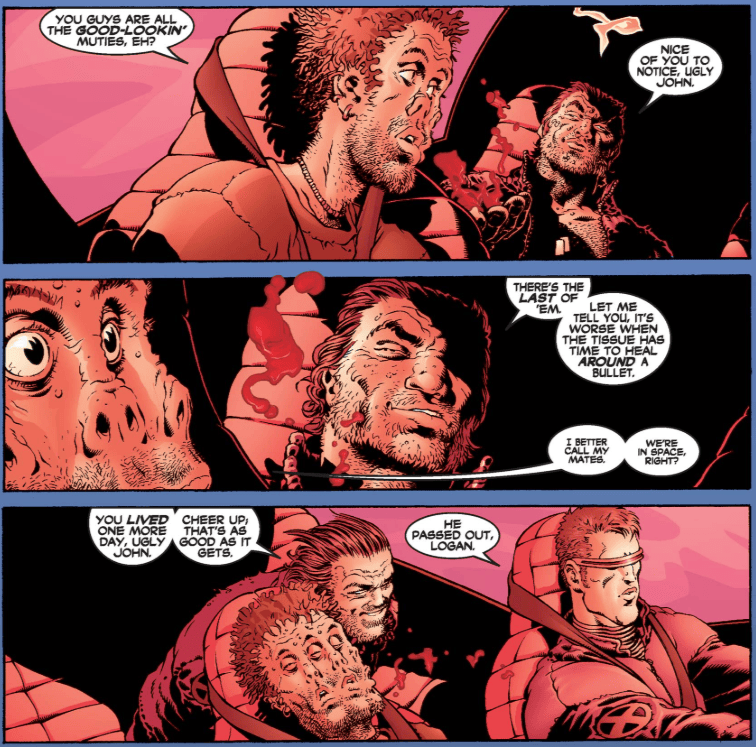
At the beginning, the credits page tells you everyone’s name. The looks and Xavier’s Mansion are changed to be more like the movie. With Ugly John in this issue, we see the rare perspective on the X-Men from a ride-along character. Kitty Pride and Jubilee served as that in the 80s, but even then they were becoming members of the X-Men themselves, and they can only be “introduced” for so long. Ugly John, however, is a full outsider. He doesn’t have desires to be an X-Man and he doesn’t know much about the team, so the reader can get accustomed to this world at the same time as him. There’s also a nice mirroring there with Trask, an unassuming dentist who is thrust into Cassandra Nova’s twisted world.
I’m going to skip forward a bit, the point of what I’m doing here is not to describe what happens, (I’m not comicpop) just commentary and analysis of parts I find interesting.
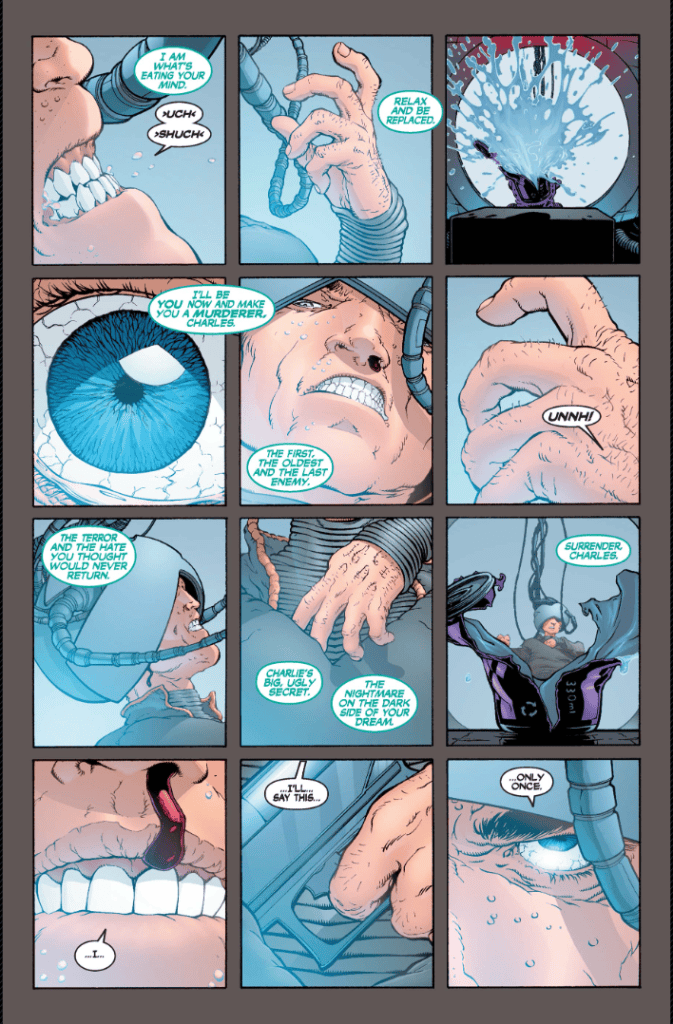
This is another standout page for me. The 12-panel grid of mostly closeups portrays the disorientation and pain Charles is feeling while under attack by disorienting the reader as well. It’s a breakup of the normal pacing but the action is followable, reminding me of the techniques this duo will later use in two other of my favorite comics- We3 and Pax Americana.
I believe that Watchmen is a comic that holds a permanent place in Grant Morrison’s mind, as it does for most of us. In Chapter 13 of Supergods, they describe it elegantly as “a devastating ‘follow this‘ to American comic-book superheroes” and a “masterpiece.” It is also clear from their writings in that chapter that they don’t think it’s as perfect as some say or the pinnacle of superhero fiction it is put up as. I have my own problems with it, and I agree with some of the qualms Morrison writes about in that chapter.
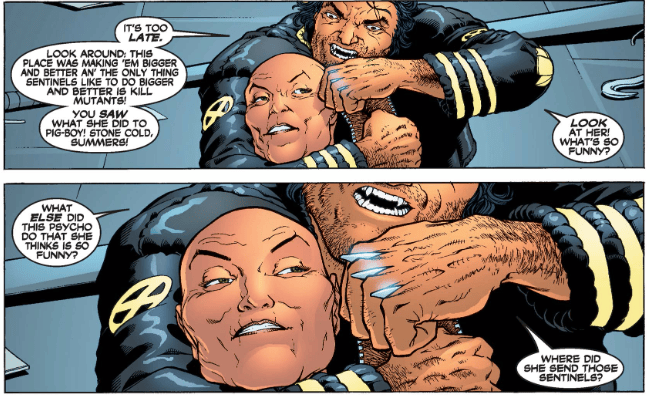
I say that because I think here, we see a mirror to the famous monologue ending with the ever-iconic “I did it thirty-five minutes ago” in issue #11. There’s no devastating line, just the carnage we see that follows. Part of this is because Morrison trusts their artists much more than Moore and is more focused on using the visuals to tell the story. From her talks with Trask, we know that she put plans in place for a genocide. There’s no mystery to be unraveled, no well-meaning billionaire with a god complex, just pure hatred. You see Nova’s grin here, a reflection of her evil and power. She’s not afraid. She’s not remorseful. We think, just as Wolverine and Cyclops do, that they can save the day, because this is how superhero stories go. But this is not just a fantasy superhero story, this is the harsh 21st century and hard hitting sci-fi of New X-Men.
Down below I’m going to put the only consecutive pages in this post, because I think it’ll be hard to get across what I’m talking about without the whole destruction of Genosha sequence.
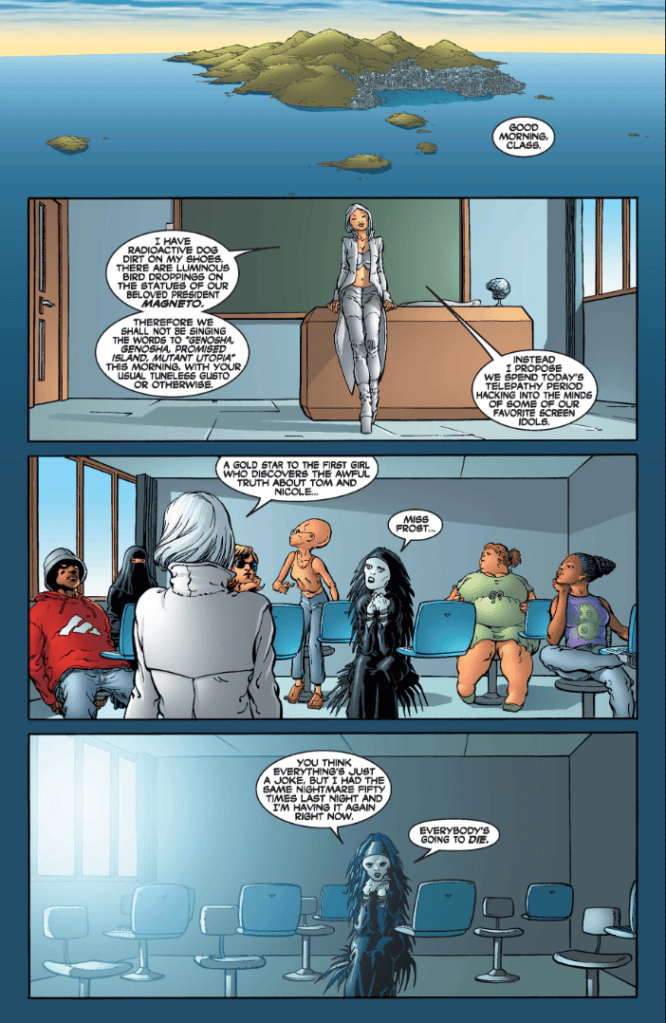
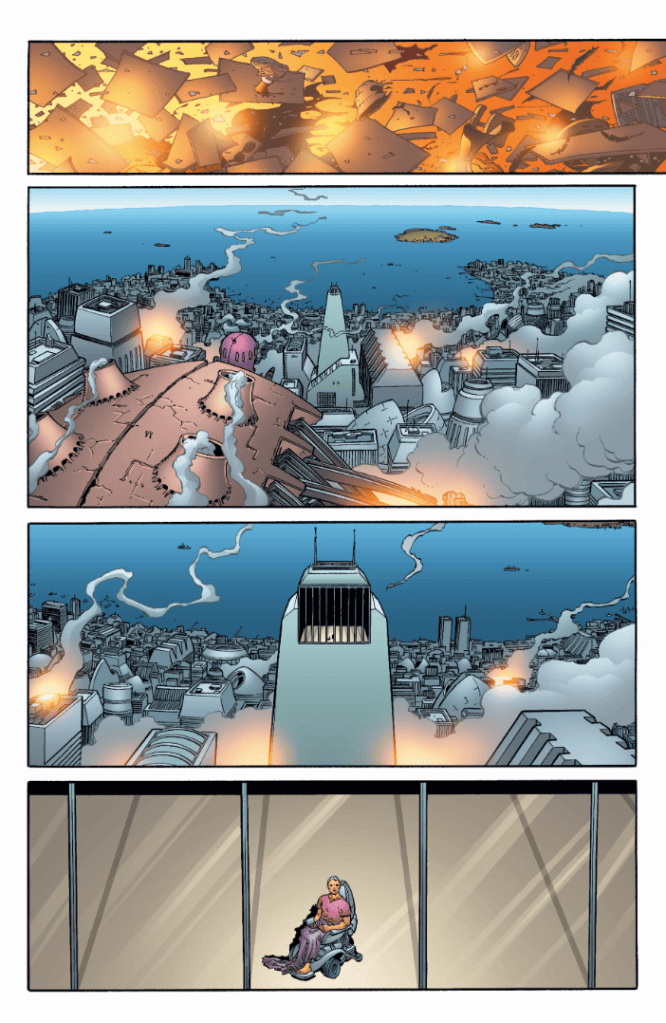
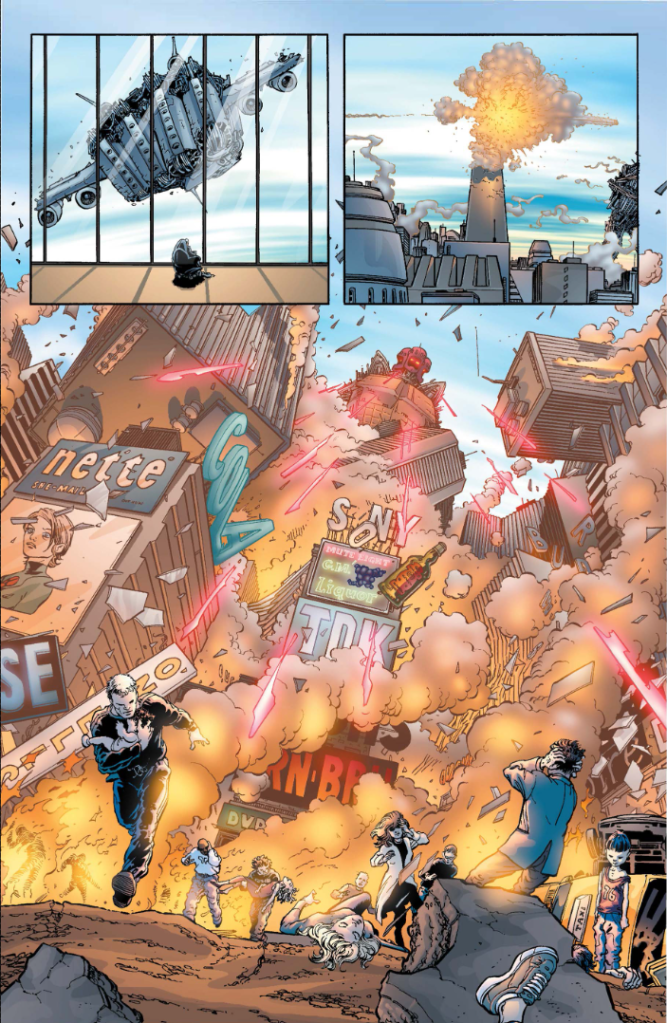
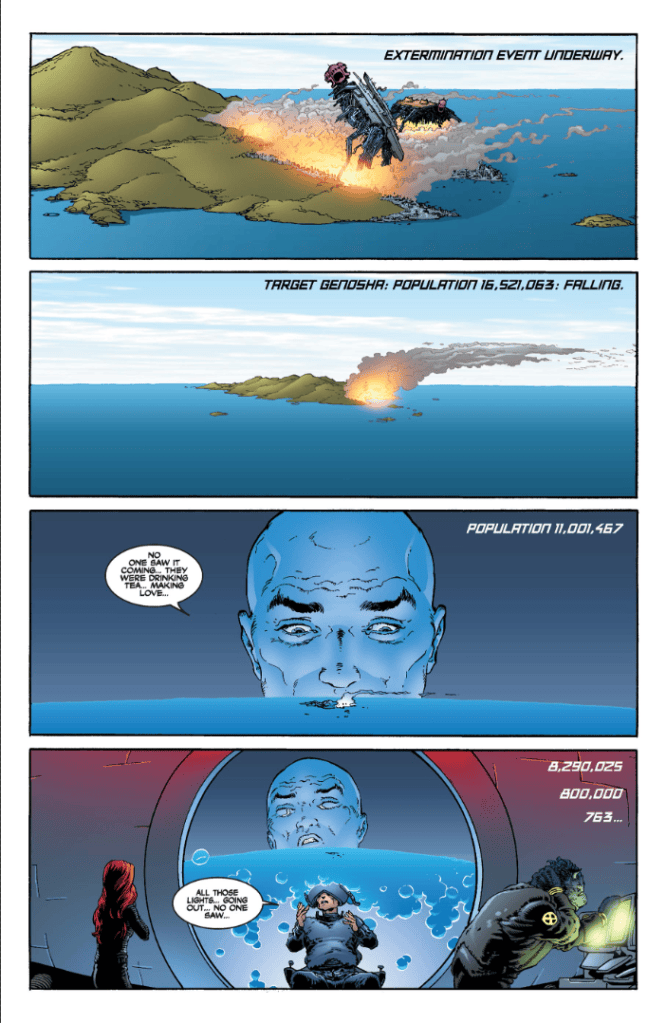
This four-page sequence is an all-time Frank Quitely great, the kind of wide screen comic storytelling he helped innovate; mixed with a great sense of movement, emotional portrayal, and silence. It starts with as slow zoom in on a disabled and helpless Magneto, the switch from the Sentinel’s perspective to Magneto’s, then shifting to the chaos of the destruction from the perspective of a dead or dying person on the ground (hence the positioning of the shoe in the bottom of the page), then finally we see it how Charles sees it in Cerebra. Note how the third page, the bleed is gone and the panel vertical sequencing is replaced by a full-page image with insert panels, exchanging removed solemnity with overwhelming chaos.
Quitely shows how they are the best artist I’m aware of at showing character’s emotion. We see the depressed fear in the student’s expression. We see the panic in the body language of the civilians on the ground, and the shock in Hank in Jean Grey’s. We feel the sadness in Charles’ eyes.
Whether or not superheroes should kill their most deadly villains is a never ending debate, seen most prominently in the Batman/Joker dynamic. There are moral arguments, Joker is a serial killer who keeps on escaping prison (or mental institutions) to go on more killing rampages. My interpretation for why Batman doesn’t kill, even the Joker, is twofold:
1) He took an oath. His father is a doctor, and he believes in the Hippocratic Oath. He sometimes wavers on it and hurts people in anger, but he knows he can never cross that final line. (This is not how all writers view Batman, such as Frank Miller, when he has Batman break people’s bones in DKR.) He knows he can’t make that decision.
2) Batman believes in reform. Batman believes that Joker and Two-Face and the rest can get better, so he has to try. That’s why he sends most of them to a mental institution, not prison. He sees that something inside them is broken, and that maybe they can become functioning members of society someday. But this is not how things work in actuality. In the real world, prison escapes are exceedingly rare, and actual serial killers and mass murderers don’t break out of prisons and go on killing rampages. Superheroes are metaphors and their universes are not real, that’s why it is essential to treat their moral dilemmas as metaphors for the dilemmas in our world and not dilemmas as if their world was real.
People are slightly more likely to believe that the death penalty should be applied to those who are guilty of murder than they are to believe that the death penalty is applied fairly, according to a Gallup Poll. This is not to mention that since the 70’s, 12% of people executed have been exonerated and they have been disproportionately Black or Latino, according to the Death Penalty Information Center. Batman works with the GCPD, so he is a pseudo-state actor. If he killed Joker and his villains, it would not metaphorically be in self-defense, it would be as a state actor and/or a vigilante.
Over the course of this issue, once the X-Men return to the mansion, is what to do about Cassandra Nova. What the X-Men represent, as they are not traditional superheroes, are not vigilantes or state actors (outside of X-Factor sometimes), but activists inside of a community of oppressed peoples. They know she will attack them, and she has already perpetrated genocide. They are not arguing about the death penalty. They operate outside of the law, so their debate about if they can kill Nova is about self-defense or the defense of others.
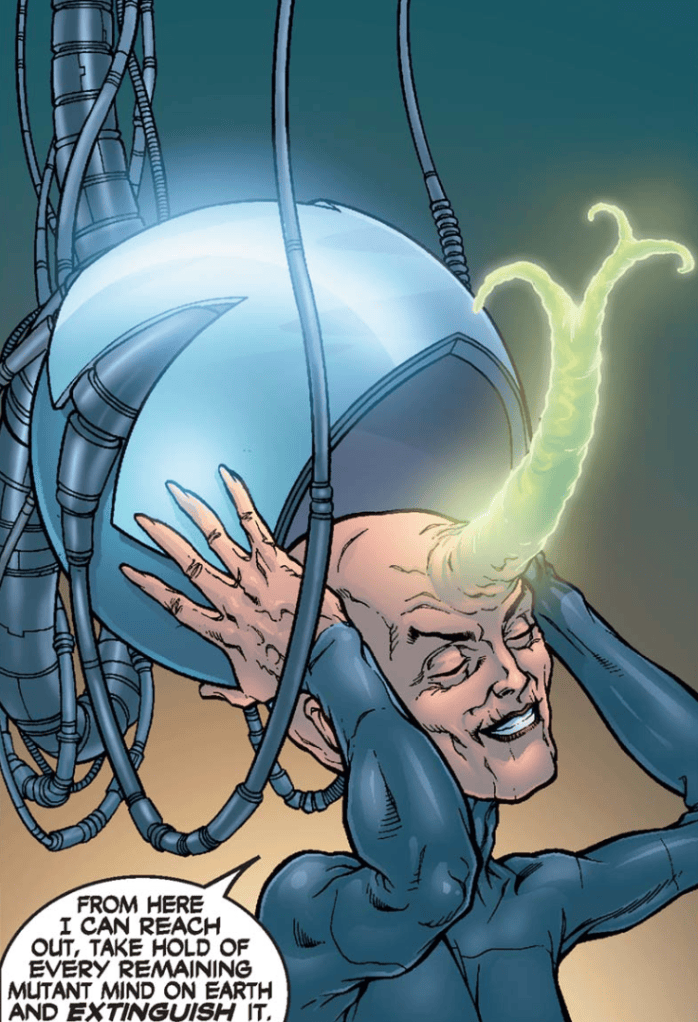
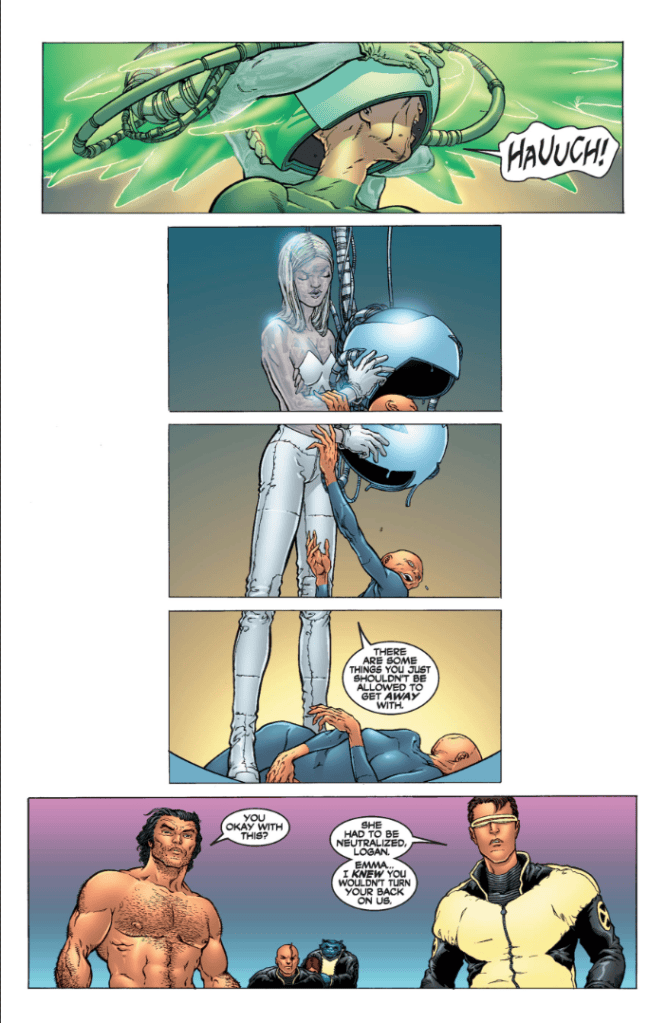
When they do make that decision, it is rendered in one of the greatest pages of the run. The neck snap comes out of nowhere. Quitely’s always so good with these types of connected panels (I forget the proper term for them), his ability to portray movement and take your eyes naturally from panel to panel is unmatched when working with Morrison. Cassandra Nova “dies” a few times this issue (don’t worry about it), but this is the one that solves the moral argument. She’s attacking them and was about to use Cerebra to kill again, so Scott agrees that they have to.
There’s a lot more character things going on too. I’d consider this the page when Emma Frost joins the X-Men, and her line of dialogue is part of her great reintroduction this issue. Emma doesn’t kill Cassandra Nova out of defense of others, but because Emma believes she has to die. We see this realignment of the X-Men, as Emma begins her road to becoming their voice, Logan deferring to Scott and Scott deferring to Emma.
Most additions to this series will likely be about more issues at a time than the just three of this one, or they’ll be shorter and about individual issues. Once we get to Riot at Xavier’s, I’m probably going to do an extended post about that one too. There’s just so much going on here and I have so many thoughts, I’m barely scratching the surface. Morrison and Quitely are my favorite duo in all of comics, so it’s hard to not gush over everything they do.
the the extra:
I mentioned it earlier, but if you want to hear what Morrison has to say about the X-Men and this run from themself, I would like to suggest their book Supergods (chapters 12 and 22 are where they talk about X-Men, but the whole thing is great).
Song recommendation: Deceptacon by Le Tigre
Patrick Willems has a great video on E is for Extinction, featuring Connor Goldsmith, the host of the Cerebro podcast. Eternal shoutouts to Cerebro, (available on major podcasting platforms) my favorite X-Men podcast, it’s very fun and gay and insightful. This run comes up frequently there.
I haven’t mentioned everyone who has worked on these issues, outside of Morrison and Quitely. Comic books are a product of everyone who works on them, not just the writers and the pencils, so I will list them here. Inks: Tim Townsend, Mark Morales, and Dan Green. Colors: Brian Haberlin. Hi-Fi, Letters: Richard Starkings,
My next essay is going to be about James Tynion IV comics, either looking at how he uses horror to talk about school shootings (Something is Killing the Children, The Woods) or how he utilizes self-inserts.


Leave a Reply